How Does Yundu Provide Lubricant Filling Solutions?

Table of Contents

Yundu is a leading Chinese manufacturer of liquid filling and packaging automation systems. With over 20 years in business and installations in more than 100 countries, Yundu has established a strong reputation for delivering turnkey packaging lines across industries (food, pharmaceuticals, chemicals, etc.). In particular, Yundu’s lubricant filling solutions are tailored to the oil and grease sector, where consistency and reliability are critical. The company’s engineering teams design complete production lines – from bottle feeding through filling, capping, labeling, sealing, and palletizing – with a focus on precision and automation. In these lines, every component is optimized for the unique demands of lubricant products, ensuring manufacturers receive an integrated system rather than isolated machines.

How Does Yundu Provide Lubricant Filling Solutions

Challenges of Lubricant Filling

Industrial lubricants (motor oils, hydraulic fluids, greases) pose several technical challenges for filling lines:

High Viscosity

Lubricant oils are much thicker than water or beverages, and their flow properties can change with temperature. Filling equipment must handle these heavy fluids without air entrapment or dripping. Machines typically use piston or gear pumps for metered delivery, and must carefully control fill speed and nozzle immersion to avoid splash and foam. Ensuring smooth, bubble-free flow is vital for consistent fills.

Precision and Accuracy

Even small volume errors waste expensive oil or cause underfilled products. Automated systems target very tight tolerances (often ±0.5–1.0% of fill volume) to meet quality standards. Advanced servo controls and real-time feedback (level sensors or load cells) help achieve this consistency. As one industry source notes, “Accuracy and precision are critical in the filling process to minimize waste and ensure consistency,” with advanced control systems adjusting the fill in real time to reduce human error.

Packaging Variety

Lubricants are sold in many package types – plastic bottles, jugs, metal cans, even drums. Each size and shape requires different handling. A flexible filling line must adapt quickly to format changes, adjusting star wheels, conveyor guides, fill heights, and nozzle types. Yundu designs modular change-over kits so that the same machinery can serve multiple formats. For example, tool-free quick-release parts enable format switches (bottle guides, nozzles, conveyors) in minutes. In practice, Yundu emphasizes “modular flexibility,” allowing a line to “easily switch between liquids, pastes, and granular products” by swapping modules or adjusting settings.

Quality and Cleanliness

Although lubricants are not food products, cleanliness and material compatibility remain important. Contaminants (dust, metal particles, water) must be excluded to protect engines. All surfaces in contact with oil are built from high-grade stainless steel (Yundu specifies 316L food-grade steel) to resist corrosion. Seals (PTFE, fluorinated rubber) prevent leaks under pressure or temperature changes. Safety is also a factor: Yundu lines use CE-certified motors and drives and include standard safety interlocks (emergency stops, overload protectors, grounding, etc.). This ensures compliance with international standards (ISO 9001, CE) and protects both product and operators.

Collectively, these factors – thick fluid handling, fill accuracy, package flexibility, and hygienic construction – require a carefully engineered solution. Yundu meets this need by offering turnkey lubricant filling lines that integrate all necessary equipment into a single automated system.

Turnkey Lubricant Filling Line Components

Lubricant production process requirements

A Yundu lubricant filling solution is delivered as a complete production line, tailored to the client’s products and packaging requirements. Typical stages include bottle (or container) handling, filling, capping, labeling, sealing, inspection, case packing, and palletizing. Below are key machines often included in a Yundu oil-filling line:

Multi-Head Servo Piston Filler

At the heart of the line is a multi-nozzle piston filler (often 8–12 heads) driven by high-precision servo motors. The servo-driven pistons draw exact volumes of oil from a supply tank and dispense them into containers. For example, a 10-head filler might handle 1–5 L bottles at up to ~2,000 containers per hour (for 5 L sizes) with fill accuracy around ±1%. The nozzles and product contact parts are made of sanitary 304/316 stainless steel or FDA-grade materials, and a level control (load cell or sensor) on each filler ensures every bottle is filled uniformly. Servo control permits rapid, synchronized filling, and the machine’s PLC touchscreen interface allows operators to set volumes and store recipes easily.

Multi-Head Servo Piston Filler

Servo-Driven Capping Machine

After filling, containers move to a capping station. Yundu typically uses a dual-head servo capping machine with vibratory cap feeders. The caps are fed into two hoppers and placed onto bottles by 2 servo-driven grippers or spindles. Servo control provides precise torque, ensuring caps are tightened consistently without cross-threading. These machines can run at speeds matching the filler (e.g. ~2,000 bottles per hour) and automatically adjust for different cap heights/types when changeover kits are applied.

Servo-Driven Capping Machine

Dual-Side Labeling Machine

To label the bottles, a dual-head wrap-around labeler applies front and back labels in one pass. This machine accommodates the label roll specifications and bottle shapes provided by the customer, and it uses photo-sensors to align each label. Typical labeling speeds are on the order of the filling speed (around 2,000 labels/hour) with position accuracy within ±1 mm. The labeling unit is fully integrated into the conveyor so that bottles proceed seamlessly under the label heads.

Dual-Side Labeling Machine

Induction Foil Sealer

For leak-proof packaging, especially if a foil seal is required, an induction sealing head is included. This machine applies a cold foil liner onto the open mouth of each bottle or can under the label. As bottles pass under the induction coil, the foil is fused to the container rim, creating a tamper-evident, hermetic seal. Yundu’s foil sealing units are designed for high throughput (around 2,000 units/hour) and include mechanisms to reject any bottles that fail to seal properly.

Induction Foil Sealer

Inline Checkweigher

Immediately after sealing, an inline checkweigher inspects each filled container. The scale verifies the actual fill weight against target, automatically rejecting underweight or overweight bottles with a pneumatic pusher. Accuracy is typically around ±2 g on a full bottle. This QC step prevents out-of-spec products from continuing down the line. Yundu often integrates the checkweigher with the line’s PLC so that data and rejects are logged in real time.

Case Erector and Packer

Completed bottles are next grouped into cases. A case erector opens flat cardboard boxes and places them on a conveyor. An automatic case packer then arranges bottles into the cases (typically by drop-packing or in-feed methods). For lubricant bottles, a drop-in packer is common: as each case opens and advances, a timed pusher drops a fixed number of bottles into it (e.g. 10 bottles per case for 1 L bottles). These machines can also run at high speeds (~2,000 bottles/hour) to match the rest of the line. The case packer frame is stainless steel and houses controls (PLC/HMI) to adjust box dimensions and fill patterns as needed.

carton opener
carton opener
carton filler
carton filler

Case Sealer

After packing, the cases move under a case sealer (folder/sealer) that closes the top flaps and applies tape. The sealer can adjust to different case heights and widths, ensuring a secure closure before palletizing.

carton sealer
carton sealer

Robotic Palletizer

On the output end, an industrial robot palletizes the packed cases onto wooden or plastic pallets. Yundu commonly uses an ABB IRB 6700 (6-axis) palletizing robot with a payload of 60 kg. The robot picks cases from the conveyor and stacks them in a pre-programmed pattern up to several meters high. This automates the heavy lifting and achieves precise stacking patterns.

palletizer
palletizer

Automatic Stretch-Wrapper

Finally, an automatic stretch-wrapping machine encases the stacked pallet in plastic film. The turntable wrapper rotates the pallet while a film carriage raises and lowers to wrap layers of stretch film around the product. These machines can wrap 40–50 pallets per hour to a height of ~1.9 meters, securing the load for transport.

wrapping machine
wrapping machine

Each of these components is integrated via conveyor belts and controlled by a central PLC. In a Yundu line, all motors and drives for conveyors, fillers, and other modules are typically CE-certified (meeting EU safety standards) and often use global brands. The machines are constructed from heavy-duty 304/316 stainless steel frames, giving corrosion resistance and durability. In short, Yundu’s turnkey approach means the customer receives a complete, interconnected system – from infeed to finished pallet – rather than individual machines.

Advanced Automation and Control Systems

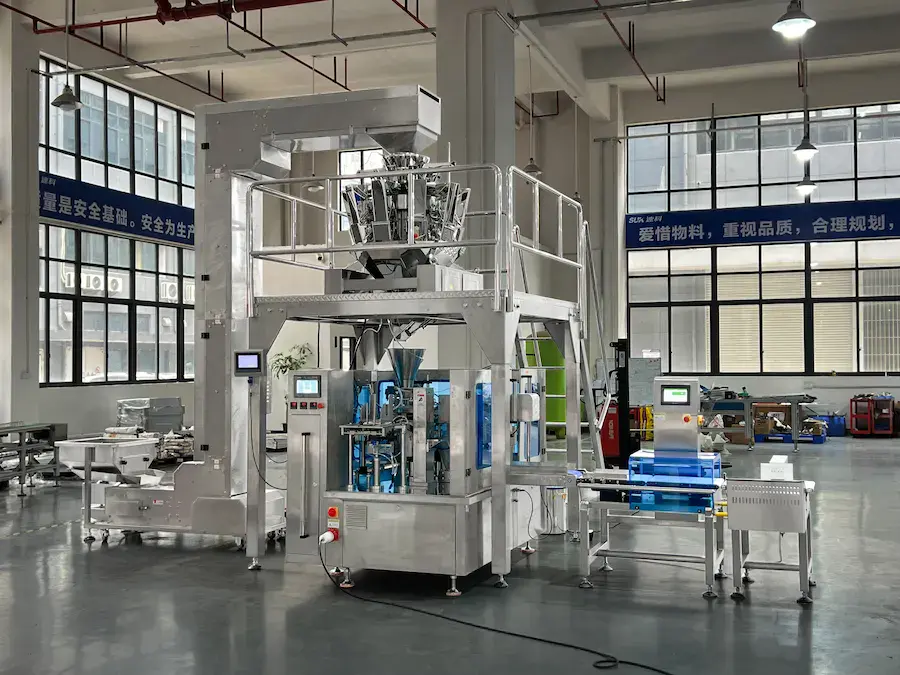
Automation is central to Yundu’s lubricant filling solutions. All key machinery in the line is controlled by a Siemens PLC and touch-screen HMI. This advanced control platform provides high-level coordination and easy operation. Operators can select product recipes (fill volume, speed, torque) via the screen, and the PLC executes synchronized start/stop of all units. For example, the filling machine’s servo pistons, capping heads, and labeling modules are all timed together so that each bottle flows through the line without interruption. Built-in safety and interlock logic within the PLC prevent jams or collisions: if a sensor detects a fault (e.g. a stopped conveyor or misaligned bottle), the system will automatically pause to avoid spills or damage.

Yundu also uses high-quality electrical and pneumatic components. Servo motors and drives (typically from established suppliers) power the filler and capping systems for fast response and precision. Variable-frequency drives control conveyor speeds to match line flow. All these parts – from sensors (often Leuze or similar) to air valves (AIRTAC/SMC) – are chosen for reliability and global support. In practice, this means the automated lubrication line can run unattended (one or two operators monitor it) while maintaining extremely consistent performance. Yundu’s engineers emphasize that advanced controls and PLC automation are key to “high-level and stable automation”, enabling long production runs with minimal downtime.

Robust Construction and International Standards

Every Yundu lubricant filling system is built for an industrial environment. The machine frames, hoppers, and hoppers are made from sanitary stainless steel – typically 304 or higher-grade 316L (the latter on critical fluid-contact parts). These metals are chemically inert to oils and easy to clean, ensuring long life and preventing contamination. Structural supports and cabinetry are also metal (not plastic), giving rigidity to handle the vibration of motors and the weight of full bottles.

To meet international customers’ requirements, Yundu adheres to global safety and quality standards. All electrical components and wiring are CE-certified, and the assembly follows ISO 9001 quality management protocols. The use of industrial-grade components (Siemens PLCs, Schneider or Siemens electricals, ABB robots, etc.) reflects this commitment. In addition, each line includes multiple safety devices: emergency-stop buttons around the line, light curtains or guards at pinch points, overload protection on motors, and leak/fault detection (e.g. ground-fault interrupters). These features not only protect operators, but also help clients meet audit requirements in regulated markets.

Yundu also pays attention to material compatibility for lubricants. All seals and gaskets in contact with oil are made of robust polymers (PTFE, Viton fluorocarbon) to withstand hydrocarbon attack. This prevents premature wear and ensures the line can handle various lubricant chemistries (mineral, synthetic, additives, etc.) without degradation. In summary, the construction and certification of Yundu’s machinery guarantee that the lubricant filling solutions comply with industry and regional regulations, while maintaining a hygienic, maintenance-friendly design.

Modularity, Flexibility, and Customization

Yundu’s lines are designed to be modular and reconfigurable. Instead of a monolithic machine, each function (filling, capping, labeling, etc.) is a separate module on the conveyor. This allows customers to scale and customize the system. For instance, a small producer might start with a single filling and capping module, while a large plant might deploy multiple fillers in parallel. Optional modules – such as case printers, vision inspection units, secondary pumping stations, or different labeling modes – can be added as needed.

Format changeover is built in to the design. Keys parts like nozzle holders, star wheels, and guide rails use hand knobs or quick clamps for tool-free adjustment. Yundu highlights “fast changeover: tool-free quick‑release parts enable product switches in under 10 minutes”. This means a line set up for, say, 2 L bottles today can switch to 5 L jugs tomorrow without lengthy downtime. Because the PLC stores multiple recipes, operators can recall settings (fill volumes, conveyor speed, label position, etc.) at the touch of a button, further speeding changeovers.

Customization is available in many forms. The control software can be tailored to client preferences (languages, UI, data logging). Machines can be fitted with different pump types (e.g. peristaltic or eccentric screw pumps instead of pistons) if needed for very thick or abrasive lubricants. Yundu even offers aesthetic options: surfaces can be polished or painted per customer branding. In practice, Yundu works closely with each customer’s engineering team to map out the line layout (floor plan, utilities), desired capacity, and any special requirements (explosion-proof electricals for flammable oils, for example). This high level of flexibility – both in hardware and control logic – ensures the solution matches the customer’s processes, not the other way around.

High Throughput, Quality and Efficiency

Yundu’s lubricant filling solutions are engineered for high productivity. With multiple fillers, infeed robots, and synchronized conveyors, the lines achieve throughputs of thousands to tens of thousands of bottles per hour (per line). For example, a single 10-head filler might run at ~2,000 bottles/hour, and more heads or parallel fillers can scale capacity upward. The Q&A on Yundu’s website notes that their machines can handle 2,000–10,000 bottles/hour with very low downtime. This means customers can meet large production targets with only minimal labor. In fact, Yundu reports that one production line can often be operated by just 1–2 people, freeing up staff for other tasks.

Automation also drives quality assurance. The PLC tracks each batch of lubricant processed, and recipe settings ensure every container is filled to spec. Inline sensors (level detectors, cameras, torque sensors on capping) watch for errors – any deviation (like a missing cap or an empty spot) immediately stops the line. As noted above, the checkweigher removes any unit outside tolerance. By combining these measures, Yundu’s solution virtually eliminates human error. An industry study highlights that “advanced control systems adjust and monitor the filling process in real time, reducing human error”, which directly improves first-pass yield.

Finally, Yundu emphasizes service and support. After commissioning the lubricant line, Yundu provides documentation (manuals, circuit diagrams), staff training, and a 12-month warranty on core components. Spare parts (e.g. seals, sensors) are stocked through their global distributor network. Software updates and remote diagnostics are available so that any issues are quickly addressed. This long-term partnership approach helps ensure the high-speed, high-quality operation continues for years.

Overall, Yundu’s lubricant filling solutions integrate advanced engineering with practical automation to solve the sector’s challenges. By using servo-driven piston fillers, dual capping and labeling heads, robotic palletizing, and a Siemens PLC/HMI control platform, Yundu delivers lines that are fast, accurate, and reliable. High-grade materials (316L stainless) and certifications (CE, ISO 9001) underscore the quality of the system. The modular design means future needs can be met by adding or reconfiguring modules. As a result, lubricant manufacturers gain a comprehensive, turnkey solution that improves throughput and consistency while minimizing waste and labor.

Lubricant Filling Solution FAQ

Transparency is the cornerstone of our Yundu team, so here are the most common questions and answers we receive surrounding our lubricant filling solution.

A turnkey solution is a complete, ready-to-run production line that integrates bottle handling, filling, capping, labeling, sealing, inspection, case packing, palletizing, and wrapping—delivered and installed by a single supplier.

Yundu employs multi-head servo-driven piston fillers, offering precise, bubble-free dispensing of thick lubricants at speeds up to 2,000 bottles per hour.

With servo control and level-sensor feedback, Yundu’s fillers achieve filling tolerances of ±1% or better, minimizing product waste and ensuring consistency.

Yes. Yundu’s modular design and quick-release change parts allow fast, tool-free format changeovers across bottles, jugs, and cans from 1 L to 5 L (or customized).

The line features a dual-head servo capping machine for consistent torque plus an induction foil sealer for tamper-evident, hermetic seals on every container.

An inline checkweigher verifies each fill weight (±2 g) and rejects out-of-spec bottles using pneumatic pushers, fully integrated with the PLC for real-time data logging.

All modules run on a Siemens PLC with HMI touchscreen, offering recipe storage, synchronized operation, safety interlocks, and easy operator interface.

Yes. Yundu uses CE-certified motors and drives, ISO 9001–compliant assembly, stainless-steel construction, and multiple safety devices (E-stops, light curtains, overload protection).

Cases are erected and drop-packed automatically, sealed with tape, and then palletized by an ABB IRB 6700 robot before stretch-wrapping up to 1.9 m high.

Absolutely. Its modular layout allows adding or swapping modules (additional fillers, vision inspection, alternate pumps) and recalling product recipes for quick adaptation.

Share The Post Now:
Picture of Hey there, I’m Daisy

Hey there, I’m Daisy

I’m the Sales manager of Yundu. We have been helping manufacturing industries increase their productivity and capacity with our advanced filling machines for over 20 years.
Have questions? Reach out to us, and we will provide you with a perfect solution.

Related Articles

Get Instant Quote

If you’d prefer, a representative from Yundu can contact you directly. Please provide the information below and a member of our sales team will contact you shortly. * fields are required.