 English
  Arabic
  Indonesian
  Vietnamese
  Malay
Malay  Thai
Thai  Korean
  Russian
  French
  Italian
  Japanese
  Portuguese
  Turkish
  Spanish
 Introduction
In recent years, with the rapid rise of precision medicine and continuous breakthroughs in biopharmaceutical technology, the pharmaceutical packaging industry has been undergoing a profound transformation. According to the latest industry news and market data, global demand for dental anesthetics, insulin, GLP-1 weight-loss drugs, and premium medical aesthetic products such as hyaluronic acid has grown explosively. Under this trend, traditional vials and ampoules can no longer fully meet the requirements of modern precision drug delivery.

This brings us to today’s core topic — the cartridge bottle and the key production equipment behind it: the Cartridge bottle filling machine.
Many customers who are new to pharmaceutical production lines or considering equipment upgrades often ask:
“What exactly is a cartridge filling machine? How is it different from traditional filling equipment? And how do we choose the right machine?”
Today, as a professional manufacturer with years of hands-on experience, we will comprehensively explain the secrets behind cartridge bottle filling machines.
I. What Is a Cartridge and Why Is It So Important?
Before understanding the machine, we first need to understand what a cartridge bottle is.
A cartridge, also known as a pen injector cartridge, is a cylindrical glass container with openings at both ends. The front end is sealed with a rubber stopper and aluminum cap, while the rear end contains a movable rubber plunger. During use, it is typically paired with a dedicated injection device such as an insulin pen or dental syringe, where the plunger pushes the liquid medication out with high precision.
The advantages of this design are obvious:
- High-Precision Drug Delivery
It eliminates human dosing errors common with traditional syringes, making it especially suitable for medications requiring extremely accurate dosage control. - Prevention of Secondary Contamination
The medication remains sealed inside the cartridge. During injection, the needle pierces the front rubber stopper directly, avoiding liquid transfer in open environments. - Patient-Friendly Design
Cartridges are portable and easy to operate, significantly improving the home treatment experience for chronic disease patients such as diabetics.
Because the cartridge structure is far more complex than ordinary pharmaceutical containers — particularly regarding dual-end sealing and plunger handling — the cartridge filling machine was specifically developed. It is a highly customized pharmaceutical automation system designed for the unique processes of washing, siliconization, sterilization, filling, stoppering, and capping of cartridges.
II. The Core Working Principle of a Cartridge Bottle Filling Machine
A complete fully automatic cartridge bottle filling production line (such as a mainstream 1.8ml dental anesthetic cartridge line) operates through a highly precise automated workflow. Taking our self-developed production line as an example, the process mainly includes the following key stages:
1. Ultrasonic Washing & Siliconization
Before entering the filling stage, cartridges must achieve absolute sterility and cleanliness.

The glass cartridges first enter an ultrasonic washing machine. Ultrasonic generators create cavitation effects in the water tank, powerfully removing particles from both the inner and outer walls of the cartridges.
After washing, one extremely critical step follows: siliconization.
Since the rubber plunger at the cartridge tail must move smoothly during injection, the machine evenly sprays a thin layer of pharmaceutical-grade silicone oil onto the inner wall of the cartridge to reduce friction during plunger movement.
2. Sterilization & Drying/Baking
The siliconized cartridges then pass through a hot air circulation tunnel oven via a conveyor belt.
This process is not only for sterilization and depyrogenation, but also for baking and curing the silicone oil onto the glass surface. Proper curing prevents silicone oil from contaminating the medication.
The system automatically balances air pressure across three temperature zones, ensuring:
- Internal cartridge temperatures reach ≥320°C
- Sterilization and silicone curing times exceed 5 minutes
3. Precision Filling
This is the heart of the entire system.
Since the cartridge already contains a rubber stopper or plunger at the rear end, the liquid must be filled from the open front side.
To prevent splashing and bubble formation, high-end cartridge filling machines use servo-driven peristaltic pumps or ceramic pumps for synchronized multi-step filling.
4. Vacuum Stoppering & Capping
After filling, the machine quickly inserts the front rubber stopper into the cartridge opening.
At this stage, precise microbubble control becomes a major technical barrier within the industry.
Next, aluminum caps are automatically fed into position, and the machine performs the final crimping process to completely seal the cartridge.
III. Main Types of Cartridge Filling Machines

Depending on production scale, budget, and application scenarios, cartridge filling machines are mainly divided into two categories:
Type 1: Fully Automatic High-Speed Cartridge Filling Lines
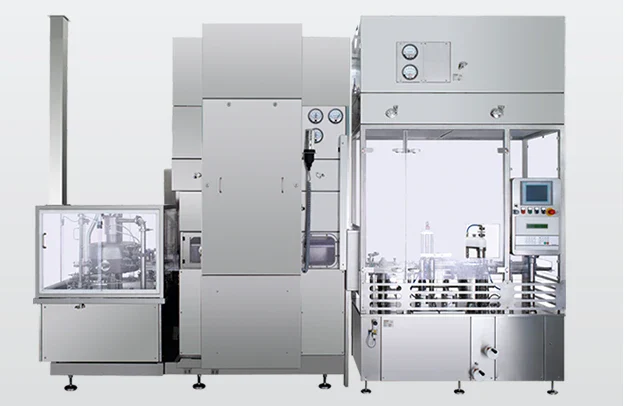
These systems are designed specifically for pharmaceutical mass production and integrate all processes including washing, drying, sterilization, filling, and sealing.
For example, our 1.8ml cartridge washing, siliconization, drying, sterilization, filling, and sealing production line can achieve a production capacity of 4,000 bottles/hour.
Configuration Overview
Such systems typically include:
- QCL40K Ultrasonic Washing Machine
(Capacity up to 4,800 bottles/hour) - SZA620/43 Hot Air Circulation Tunnel Oven
(Featuring automatic conveyor cleaning and automatic air-pressure balancing) - YKS2A Cartridge Filling Machine
(Core filling unit)
Suitable Applications
- Dental anesthetics
- Large-scale insulin production
These production lines operate fully automatically under Grade A laminar airflow protection, minimizing human intervention and ensuring aseptic conditions.
Type 2: Desktop Semi-Automatic Prefilled Cartridge Machines
For pharmaceutical research institutions, university laboratories, or startups entering the cartridge market, investing directly in a large-scale production line may be impractical due to cost and space requirements.
In such cases, desktop semi-automatic machines like the YCF-1BK are the ideal solution.
Configuration Overview
Operators manually place pre-cleaned, siliconized, and sterilized cartridges into the fixture slots.
The machine consists of two independent stations:
- Filling station
- Stoppering station
After pressing the start button, the machine automatically performs:
- Precision filling
(Servo-driven peristaltic pump with automatic nozzle lifting) - Stoppering
(Vibratory bowl feeder with precision stopper insertion)
Suitable Applications
- Clinical trial batches
- New drug R&D
- Small-batch premium medical aesthetic products such as collagen and hyaluronic acid
After filling and stoppering, cartridges can be transferred manually to a semi-automatic capping machine for final sealing.
IV. Core Applications and Industry Cases
The applications of cartridge filling machines continue expanding alongside medical innovation.
1. Dental Local Anesthetics
This remains the most classic and highest-volume market for 1.8ml cartridges.
Because dental procedures require extremely precise dosage control and specialized metal syringes, cartridge-based anesthetics have become the preferred choice for dentists worldwide.
Major dental consumable manufacturers are actively investing in automated cartridge filling lines.
2. Diabetes & Endocrine Therapy
Applications include:
- Insulin pens
- GLP-1 drugs such as Semaglutide
These high-value biologics rely heavily on cartridge systems for safe and convenient self-injection at home.
3. Emergency & Specialized Medications
Examples include epinephrine auto-injectors (such as EpiPen-type products).
In emergency allergy treatment, cartridge packaging ensures rapid one-step injection reliability.
4. Medical Aesthetics
High-end injectable products such as:
- Hyaluronic acid
- Botulinum toxin
- Collagen solutions
are increasingly adopting cartridge packaging to improve injection precision and user experience.
V. Breaking Technical Barriers: The Core Advantages of Yundu Cartridge Filling Machines
As a real manufacturing factory rooted in Guangzhou and Wenzhou, Yundu would like to clearly state:
We are a direct source manufacturer, not a middleman or trading company profiting from price differences.
We own:
- Our own R&D team
- Precision machining workshops
- Assembly and testing centers
Because we fully control the core technology, Yundu cartridge filling machines possess irreplaceable advantages in the market.
1. Innovative “Bubble-Free” Multi-Step Filling Technology
In injectable products such as anesthetics, bubbles are considered fatal defects.
Our YKS2A cartridge filling machine pioneered a flexible filling-head configuration within the industry.
4-Head Configuration
- Two-stage filling
- High production efficiency
- Minimal microbubble residue possible
- Suitable for standard products
Core Advantage: 6-Head Configuration
- Three-stage step-by-step filling
- Servo-driven liquid-level tracking technology
- Completely eliminates bubble formation
- Achieves true zero-bubble filling
This breakthrough solves one of the biggest technical pain points in cartridge filling.
2. Full Servo Control & Exceptional Yield Rates
Whether it is a large automatic production line or the compact YCF-1BK semi-automatic machine, we have fully abandoned outdated mechanical cam systems in favor of full servo motor drive systems.
This allows engineers and operators to digitally adjust parameters directly via the touchscreen, including:
- Filling needle lifting height
- Movement speed
- Stoppering depth
As a result:
- Filling accuracy reaches ±1%
- Stoppering qualification rate ≥99%
- Capping qualification rate ≥99%
3. Standard Industrial IoT Remote Diagnostic Module
We understand that downtime costs for overseas pharmaceutical companies can be extremely high.
Therefore, Yundu cartridge filling machines come standard with advanced remote diagnostic modules.
Customers simply connect the machine to the internet using a standard network cable, allowing our engineers to remotely:
- Monitor operating data
- Perform troubleshooting
- Conduct remote maintenance
- Upgrade PLC programs and software
This “zero-distance” technical support is something ordinary trading companies simply cannot provide.
4. Stable and Reliable Sterilization System
Taking our SZA620/43 hot air circulation tunnel oven as an example:
- 43KW high-power electric heating system
- 600mm effective conveyor width
- Integrated 1KW ultrasonic conveyor cleaning system
Its unique three-zone automatic air-pressure balancing technology effectively prevents cold air backflow, ensuring highly stable sterilization temperatures and perfect silicone curing performance.
VI. Conclusion
From desktop semi-automatic laboratory equipment to fully automatic high-speed production lines capable of producing 4,000 cartridges per hour, cartridge filling machines are safeguarding human health and medication safety through extremely advanced technology.
Choosing the right machine means choosing a reliable production future.
As a true source manufacturer, Yundu not only provides highly competitive factory-direct pricing, but also offers full lifecycle support including:
- Project planning
- Equipment manufacturing
- Installation & commissioning
- Remote technical maintenance
If you are planning a project related to dental anesthetic cartridges, insulin cartridges, or medical aesthetic cartridge products, feel free to contact us directly.
Visit our factory and witness real machine operations firsthand — let us show you the power of Chinese intelligent manufacturing through truly professional pharmaceutical automation equipment.