 English
  Arabic
  Indonesian
  Vietnamese
  Malay
Malay  Thai
Thai  Korean
  Russian
  French
  Italian
  Japanese
  Portuguese
  Turkish
  Spanish
 Liquid-Filled Capsules: HPMC vs. Licaps – Materials, Processes, and Machinery
Executive Summary: Liquid-filled capsules are specialized hard-shell capsules designed to encapsulate oils, suspensions or semi-solids instead of powders.
Licaps (a Capsugel/Lonza technology) are two-piece hard capsules (gelatin or HPMC) filled with liquid and hermetically sealed by a patented LEMS (Liquid Encapsulation Microspray Sealing) process. In contrast, standard HPMC capsules are plant-based cellulose shells usually filled with dry powders. This deep-dive covers material composition, filling processes, suitability for extracts, stability/leakage, regulatory certifications (GMP, HACCP, ISO), COA/testing parameters, application cases, and equipment (with emphasis on Yundu’s liquid capsule fillers).
We compare capsule types in a table, outline workflows for powder vs liquid filling (and Licaps), and provide QA checklists and example COA fields. Throughout, we cite industry and manufacturer sources. Yundu’s NYF-1000 fully-automatic liquid capsule filler can handle liquids, suspensions or melts and seals capsules for enhanced stability.
1. Capsule Materials: HPMC vs. Licaps Shells
HPMC Capsules: Hydroxypropyl methylcellulose (HPMC), also called hypromellose, is a plant-derived polymer used for vegetarian hard capsules. HPMC shells offer a natural, GMO‐free alternative to gelatin; they tolerate higher heat and humidity than gelatin (e.g. stable at 15–30 °C, 35–70% RH) and resist gastric acid, making them ideal for moisture- or acid-sensitive formulations. HPMC capsules are “100% vegetable-derived” and favored for hygroscopic (moisture-attractive) APIs.

They do not contain plasticizers (unlike softgels) and generally have no added animal ingredients, suiting halal/vegan labeling. Some HPMC capsules (e.g. Capsugel Vcaps® Plus) use co-gelling agents (gellan gum) to improve physical properties or achieve specific certification (organic). However, most standard HPMC shells are pure hydroxypropyl methylcellulose without gelatin or glycerin.
Licaps Capsules: Licaps are a liquid-filled hard-capsule system originally developed by Capsugel (Lonza). Licaps shells can be made from gelatin or vegetarian polymers (e.g. HPMC, pullulan), including specialty blends like HPMC‐gellan. Early Licaps used fish-derived gelatin (naturally plasticizer‐free, excellent oxygen barrier). To meet vegan/organic demands, Capsugel introduced Licaps with HPMC (and variants like HPMC‐gellan). The result is an oxygen-impermeable shell without any plasticizers (no glycerin), which avoids microchannels and improves shelf life.

Yundu’s liquid capsule filling solution.
Importantly, all Licaps shells (gelatin or HPMC‐based) are produced under cGMP conditions with full quality certification (ISO, GMP, etc.). In summary, HPMC capsules are a generic plant-based hard capsule for powders, whereas Licaps capsules are a proprietary two-piece design (gelatin or HPMC shell) intended for liquid or semi-solid fills.
2. Capsule Types Comparison
Hard gelatin capsules can hold some oils if banded, but are mainly for solids. HPMC capsules can hold oils with banding/sealing but are designed for solids. (Licaps fill instructions specifically discourage dry powder fills – they are meant for liquids only.)
3. Filling Processes: Dry vs. Liquid
Dry-Fill (Powder): Standard hard-capsule machines (semi-auto or automatic) separate capsule caps and bodies, then fill the body with powder or granules (using tamping or auger), and finally reunite the cap. No heat sealing is needed; capsules rely on friction or optional banding seal for security. For example, Yundu’s semi-automatic filler can load empty gelatin or HPMC capsules (sizes 00–5) and dispense powders, granules or even viscous liquids using an auger or pump. Quality checks (capsule weight, fill accuracy) are done as needed.
Liquid-Fill (Licaps/LEMS): Liquid capsule filling requires specialized steps. Empty Licaps shells are loaded; liquid (oily or aqueous solution) is dosed into the capsule body via a pump (gear or piston pump). Air inside is often purged with inert gas (N₂) to remove oxygen.
Then the capsule is sealed by the LEMS method: a micron-scale spray of solvent (e.g. water/ethanol) wetting agent at the cap-body joint followed by gentle heating (40–60 °C) fuses the shell material. The machine then holds capsules in trays until fully set. Compared to simple banding (a strip of gelatin), LEMS creates a bandless, one-piece hermetic seal with a much larger bonded area.

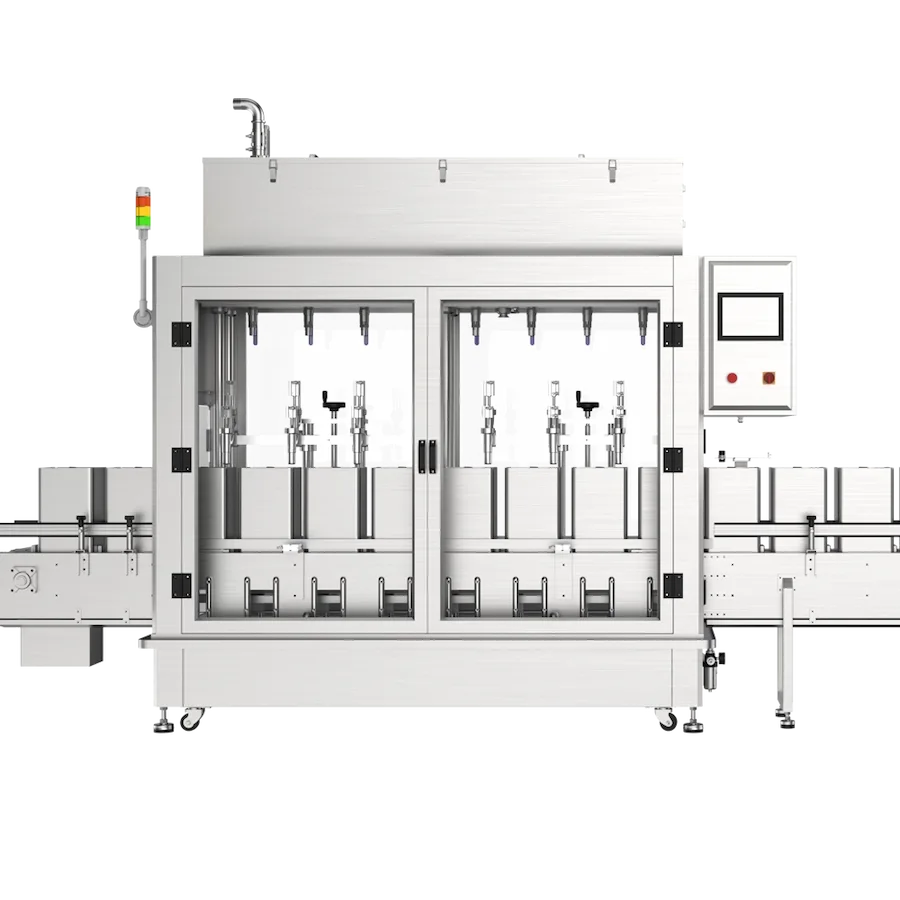
Yundu’s NYF-1000 fully-automatic liquid capsule filler integrates all these steps: capsule separation, inspection, liquid dosing (solutions, suspensions, hot melts, etc.), then joint sealing.

Liquid capsule filling machine discharge station
This closed-turntable system automates the entire liquid-filling and sealing process, improving throughput and ensuring no leakage during handling. (A semi-auto liquid filler, like Yundu’s bench unit, also exists for R&D or small batches.)
4. Suitability for Extract Powders vs. Liquids
Extract Powders: Dry plant extracts or herbal powders (e.g. dried botanical extracts) are best filled into standard hard capsules (gelatin or HPMC). HPMC shells are especially popular for hygroscopic extracts because they tolerate moisture and temperature variation. There is no benefit to using Licaps shells for dry powders; Licaps are engineered for liquid payloads, not powders. In practice, powder extracts are filled on conventional powder capsule-filling lines. Yundu’s dry capsule machines handle powders and granules with high accuracy (±3–5% for powders).
Extract Liquids/Tinctures: Liquefied botanical extracts, oils, or low-water-content suspensions suit Licaps or softgels. For example, fatty botanical oils (turmeric oil, fish/krill oil, CoQ10 suspensions) and liquid vitamin extracts are ideal for Licaps. Licaps’ hermetic seal prevents leakage of potent oils during packaging. Note that Licaps capsules must remain upright (e.g. horizontal orientation during filling) and sealed promptly after fill to avoid leaks. In summary, use dry capsules (HPMC/gelatin) for powder extracts, and liquid capsules (Licaps/softgel) for oil or tinctured extracts. It is generally not practical to put dry powder into Licaps-style shells, since their filling/sealing process is designed for liquids.
5. Stability and Leakage Risks
Moisture/Oxygen Barrier: Licaps capsules offer superior barrier properties because of their fused, plasticizer-free shell. Capsugel reports that Licaps have “less oxygen permeability than softgels”, greatly enhancing shelf life of sensitive oils. Because no glycerin or gelatin additives are used, Licaps do not develop microchannels that could let oxygen or odor escape. In fact, GSK found that in rigorous stability tests, Licaps “had intact seals” with no leakage, preserving product quality. Standard HPMC or gelatin capsules, by comparison, rely on humidity control and are not hermetic; if filled with liquid, they must be banded to mitigate leaks. HPMC capsules tolerate heat and humidity better than gelatin (shelf life at higher RH), but neither type is sealed.
Leakage Prevention: Any liquid fill risks leakage at the cap-body interface unless sealed. Ordinary banding (applying a thin strip of capsule material around the joint) can reduce leaks. However, banding still allows some trapped air and is only semi-hermetic. Licaps’ LEMS sealing eliminates this gap entirely. The sealing fluid penetrates and partially melts the shell edges, creating a one-piece capsule with a much wider bonded area. Post-seal, the capsule is purged of oxygen and cooled. The result is a leak-proof seal that resists mechanical stress. In practice, sealed Licaps capsules show no liquid seepage under typical packaging and shipping conditions.
Capsule Integrity (Dry vs. Liquid): Dry-filled capsules have their own QA needs (friction-fit closure, weight uniformity, disintegration). HPMC capsules, being hygroscopic, must be stored at moderate RH to prevent brittleness. Liquid-filled capsules (Licaps) require temperature control during sealing and hardening. Overheating or residual solvent can damage the seal. Yundu’s machines address this by controlled heating (40–60 °C) and cooling steps. In summary, pure HPMC shells protect powders and resist humidity, while Licaps shells provide exceptional protection for oils by virtue of their fused, plasticizer-free sealing.
6. Regulatory and Certification Considerations
Dietary supplement and pharmaceutical capsule manufacturers typically adhere to GMP (current Good Manufacturing Practices) and seek certifications like ISO and HACCP. GMP (e.g. FDA 21 CFR 210/211 for drugs, 21 CFR 111 for supplements) is mandatory for pharma/supplement lines. Capsule producers often maintain ISO 9001 (Quality) and ISO 22000 (Food Safety) systems. HACCP is a food-safety management system; in the EU, HACCP is legally required for supplements and ensures each step of production is hazard-analyzed. A manufacturer’s facility might be GMP-certified or inspected by pharmaceutical agencies, even if the end product is a supplement.
Typical capsule-makers (e.g. Capsugel/Lonza, Qualicaps, Healsee) advertise certifications such as ISO 9001, ISO 14001, HACCP, NSF-GMP, Kosher, Halal, etc.. For example, Healsee (a leading HPMC capsule producer) states compliance with GMP and HACCP, and lists ISO, Halal, Kosher, NSF approvals on its HPMC product pages. While Yundu is a machinery manufacturer, not a capsule material supplier, Yundu’s machines are built to comply with cGMP equipment standards (stainless steel contact parts, cleanability, etc.). In marketing, Yundu highlights that its filling lines meet GMP production requirements (enclosed design, dust control).
Certificates & COAs: Capsule batches come with Certificates of Analysis (COAs). While Yundu does not issue raw material COAs, capsule suppliers provide one with each order. Typical COA parameters for empty HPMC capsules include moisture (loss on drying), ash (ignition residue), heavy metals (Pb, As, etc.), microbial counts (total plate, yeast/mold, pathogens), uniformity (capsule weight, dimensions), and disintegration. Finished liquid-filled products (e.g. filled Licaps) may also have dissolution and content uniformity tests per pharmacopeial standards.
Examples: One COA from an HPMC manufacturer (Jiujiang Angtai) shows Loss on Drying 4.8%, ignition residue 0.75%, total bacteria <10 CFU/g (limits 1000 CFU/g), and negative for pathogens. Another (Zhuhai Ting Kai) shows disintegration ~6 min (limit 30 min), plate count 10 CFU/g (limit 1000), and 100% compliance in defect rates. These illustrate typical analytical fields: loss on drying, disintegration, heavy metals, microbial limits, and physical measurements. Capsule manufacturers will tailor COAs to regulatory requirements (USP/NF, EP, JP, or local pharmacopeia).
Quality Standards: In operation, Yundu’s customers would be expected to run in cGMP mode: validated equipment, qualified operators, cleanrooms if needed, and robust documentation. Yundu machines support this by using food-grade materials, easy-clean design, and automation to reduce human error.
7. Quality Testing and COA Parameters
Typical quality tests for hard capsules (empty or filled) include:
- Physical/Chemical Tests:
- Loss on Drying (Moisture)– ensures the capsule’s water content is within spec (e.g. ≤8%).
- Ignition Residue (Ash)– measures inorganic residue (e.g. ≤3%).
- Heavy Metals– limits for Pb, As, Hg, Cd (often <2 ppm total). For example, one COA shows Pb/As <0.0002%.
- Ethanol/Residual Solvents– if solvent used (should be absent in capsules).
- Disintegration/Dissolution:
- Disintegration Time– empty HPMC caps usually must disintegrate within e.g. 15–30 min.
- Dissolution– for filled capsules (with actives), per USP/EP specifications (e.g. 75% in 60 min). Liquid fills often dissolve faster.
- Microbiological:
- Total Aerobic Plate Count (TAPC)– limits (e.g. ≤1000 CFU/g). COAs above showed <10 CFU/g.
- Yeast & Mold– limits (e.g. ≤100 CFU/g).
- Pathogen Tests– Salmonella, E. coli, Staph aureus all must be absent. The COAs show “Negative” for these.
- Physical Dimensions and Uniformity:
- Capsule Dimensions– length, diameter, wall thickness tolerances.
- Weight Variation– average capsule weight and percent deviation (not shown above, but typical for filled capsules).
- Defects– % of capsules with critical, major, minor defects.
A sample COA field listing might read:
Parameter | Specification | Result
—————————-|——————-|———
Loss on Drying | ≤8.0% | 4.80%
Ignition Residue | ≤3.0% | 0.75%
Heavy Metals (Pb, As, Cd) | ≤0.002% each | <0.002%
Disintegration (empty caps) | ≤15 minutes | 12′15″
Total Plate Count | ≤1000 cfu/g | <10 cfu/g
Yeast & Mold | ≤100 cfu/g | <10 cfu/g
Salmonella | Negative/10g | Negative
Staph. aureus | Negative/1g | Negative
These illustrate how a COA records specification vs result. Filled product COAs would add assay (active content) and dissolution as required.
8. Typical Applications
Nutraceuticals & Supplements: Liquid-filled capsules (Licaps or softgels) are popular for omega-3 fish/krill oils, fat-soluble vitamins (A, D, E, K), CoQ10, and botanical oils (e.g. evening primrose, flaxseed). Yundu notes that Licaps have been used for krill oil (“Krill Omega Defense”) with improved stability. Liquid capsules are also used for botanical extracts that are oil-based (e.g. curcumin solutions, turmeric oil, sacha inchi oil). Dry HPMC capsules dominate for powdered vitamins, herbal powders (turmeric powder, ginseng powder), probiotics, and amino acids. Cosmetics sometimes use filled capsules for single-dose serums (e.g. waterless facial oil capsules) – these can be produced on similar equipment. In pharmaceuticals, Licaps can deliver oily drug formulations or combine drugs in a liquid vehicle (e.g. ophthalmic suspensions). Any API that is poorly water-soluble may benefit from being pre-dissolved in a liquid-filled capsule for faster dissolution.
Pharmaceuticals: Some drug trials use Licaps for gastro-resistant or fast-dissolving oil-based drugs, leveraging their low oxygen permeability. The pharmaceutical industry also uses high-precision capsule fillers for potent APIs (dry or liquid) – for example, Yundu’s automated filler can ensure tight dosing of highly active or insoluble drugs.
Cosmetics/Personal Care: Ingestible beauty supplements often come in capsules (e.g. collagen peptides, CoQ10, fish oil for skin health). Licaps could also be applied to topical single-dose formats (e.g. gel capsules containing face serum or hair oil), though this is a niche use.
9. Filling Equipment & Yundu’s Solutions
Yundu specializes in liquid capsule filling machines. The NYF-1000 is a fully automatic liquid capsule filler that fills hard capsules (000–5) with solutions, suspensions, microemulsions, or hot-melt fills and then seals them. It uses a 12-station rotary turntable with enclosed modules for separation, inspection, filling, sealing, and ejection. Features include fiber-optic capsule detection, hanging-drying trays, and automatic discharging. The result is a high-throughput, GMP-compliant line that maintains product in a sealed state through packaging.
【19†embed_image】 Yundu’s NYF-1000 fully-automatic hard-capsule liquid-filling and sealing machine. It doses liquid into HPMC or gelatin capsules and applies heat sealing to ensure hermetic closure.

Testing Agency for Liquid Capsule Filling Machines
Yundu also offers a semi-automatic liquid capsule filler for smaller batches. This bench-top unit automatically feeds capsules, fills up to 25,000 caps/hour (depending on size) and locks them horizontally. It is versatile: an R&D mode can fill powders or liquids with interchangeable modules. (Yundu’s FAQ notes ±3–5% fill weight accuracy for powders, and ±1–3% for calibrated liquids.) The semi-auto machine can handle cap sizes 000–5 and optional mini-caps.
Advantages of Yundu’s equipment include: integrated vacuum/N₂ purge systems (for bubble-free fills), touch-screen HMI with recipe control, and stainless-steel construction for easy cleaning. The enclosed design minimizes dust and protects operators.

Peristaltic Pump for Liquid Capsule Filling Machine
Yundu emphasizes liquid-filling focus, with machines that can fill not only oils but also suspensions, syrups, and even hot-melt formulations. For example, the NYF-1000 can handle hot-melt lipid formulations, broadening its pharma potential.
【37†embed_image】 Yundu’s semi-automatic liquid capsule filling machine can automatically feed empty capsules, fill them with liquids or powders, and cap them. Models accommodate both gelatin and HPMC shells (sizes 00–5) for versatile use.
10. Recommended Filling Workflows

Liquid Capsule Filling Machine Station Layout
A clear workflow ensures quality. The two main paths (powder vs liquid) can be summarized:
flowchart TB
subgraph Dry_Fill [Dry Filling (Powder/Granules)]
D1[Load empty capsules (HPMC/gelatin)] –> D2[Dispense powder/granules on capsule machine]
D2 –> D3[Lock capsule halves and optional band]
D3 –> D4[In-process weight check]
D4 –> D5[De-dust and discharge finished capsules]
end
subgraph Liquid_Fill [Liquid Filling (Licaps-style)]
L1[Load empty Licaps shells (HPMC or gelatin)] –> L2[Fill with liquid (pump, N₂ purge)]
L2 –> L3[Apply microspray sealing (LEMS fluid)]
L3 –> L4[Apply gentle heat (40–60 °C) to fuse edges]
L4 –> L5[Cool and inspect seal integrity]
L5 –> L6[Collect sealed liquid capsules]
end
D5 –> End[Packaging]
L6 –> End
Above, Dry Filling Workflow involves: (1) capsule feeding and alignment, (2) powder dosing (tamped or dosator fill), (3) capsule locking (and optional banding), (4) in-line weight or volume check, and (5) final capsule polishing/discharge. Machines can be semi-auto or fully-auto (e.g. 8-station rotary fillers).
Liquid Filling Workflow (Licaps) involves: (1) feeding specialized Licaps shells (captive-cap designs), (2) liquid dosing via pump (vacuum / N₂ to remove air), (3) LEMS sealing (microspray of warm polymer solution at joint), (4) heating station (air or infrared) to weld the shell, (5) cooling/tray hold for setting, and (6) final inspection (weight, leak test). Yundu’s NYF-1000 automates all these.

Liquid Capsule Filling Machine Capsule Comb
Capsule Locking and Sealing:
- After filling, a locking stationaligns and press-locks the cap and body before sealing (steps D3/L3).
- For traditional dry-fill, capsules may then be bandedwith gelatin strip (optional) for extra leak prevention.
- For liquid-fill, the LEMS process itself fuses the seam (no added band).
Inspection:
- Both workflows require checks: capsule orientation (reject upside-down caps), fill weight uniformity, and final seal integrity. Yundu machines include optical detectors to reject bad capsules during filling.
11. QA Checklist and COA Fields (Examples)
Pre-Production Checks:
- Verify raw materials: capsule shells (HPMC vs gelatin) certificate, moisture and gel content. Check powder or liquid formulation specs.
- Calibrate filling pumps/auger for target fill weight. Confirm O-ring seals, N₂ supply for liquid line.
In-Process Controls:
- Periodic weight sampling (e.g. every 30 min) to ensure ±N% fill accuracy. For liquids, verify pump calibration.
- Monitor capsule height/lock (ensure caps fully on) and nozzle blockage.
- Environmental: maintain room temperature (15–25 °C) and humidity (35–65% RH for HPMC) per capsule spec.
Post-Production Testing:
- Appearance:Capsules uniformly filled, correct sealing/banding.
- Weight Variation:Weigh 20-30 capsules for deviation.
- Leak Test:Immersion (vacuum drum) or helium to check seal for liquid capsules.
- Disintegration:Test representative capsules (especially for HPMC veg capsule, require disintegration ≤15–30 min).
- Dissolution (if API-loaded):Per pharmacopeia.
- Microbial:For supplements or non-sterile products, test TAMC/Y&M (e.g. <1000/<100 CFU/g).
- Heavy Metals:As needed by region (e.g. EU limits).
- Content Uniformity:Particularly important for potent actives.
Documentation: Record batch records, calibration logs, COA for raw capsules, final test reports. Ensure equipment cleaning validation, traceability of ingredients, and operator training are documented (cGMP compliance).
12. Certificates and COA Examples
Typical Certifications: Capsule fill lines often carry or operate under: ISO 9001 (quality), ISO 22000 or HACCP (food safety), cGMP for supplements/pharma, and sometimes Kosher/Halal for capsule materials. (Individual machines need not be certified; the facility does.) Yundu’s equipment supports GMP manufacturing (stainless surfaces, no open moving parts).
Example COA Fields: Common entries on a hard-capsule COA include:
- Appearance/Description(uniform shape, color)
- Identity(e.g. IR or spectroscopy match)
- Loss on Drying(e.g. ≤8.0%; result ~5%)
- Ignition Residue (Ash)(e.g. ≤3.0%; result ~1%)
- Disintegration Time(empty capsules, ≤15–30 min; shown ~6–12 min)
- Heavy Metals(Pb, Cd, Hg, As limits; e.g. <2 ppm)
- Total Plate Count(≤1000 CFU/g; often <10 CFU/g)
- Yeasts & Molds(≤100 CFU/g; often <10 CFU/g)
- Pathogens(E.coli, Salmonella, Staph – all absent)
- Capsule Dimensions(length, diameter tolerances)
- Weight & Defects(sample weight, allowable defect rates).
These data are documented on every batch’s COA. Finished products (with drug or extract loaded) would add assay of active, loss on drying of fill, and dissolution profiles.
Yundu’s Note: Actual Yundu certificates (like company ISO or GMP certifications) are proprietary. In general, capsule projects should demand supplier certificates (e.g. ISO 9001, HACCP) and COAs for each lot of capsules used. Yundu’s machines can be integrated into a GMP-compliant plant, but Yundu itself is not a supplement brand – it is a machine supplier.
13. Conclusions and Yundu’s Role
Liquid-filled capsules (Licaps) are a high-value dosage form offering excellent stability and bioavailability for oil-based and sensitive actives. They require specialized caps and equipment (LEMS sealing). Normal HPMC hard capsules remain the workhorse for powders and granules, prized for their clean label and stability. Choosing between them depends on the formulation (powder vs liquid), market (vegetarian/organic vs not), and desired shelf-life.
Yundu offers the machinery solutions for both worlds: dry and liquid capsule filling. Its NYF-1000 and bench-top fillers can process HPMC or gelatin shells, dosing powders or liquids as needed. Emphasis on automation and sealing makes them ideal for manufacturing advanced Licaps-type products. In practice, a manufacturer might use a standard capsule filler (semi or auto) for extract powders, and a Yundu liquid-filling line for oily extracts or formulations requiring sealing.
Table: Workflow & Machines (as above) outlines recommended steps. The QA checklist above outlines critical control points (CAPAs, calibration, environmental controls, microbial limits, etc.). Finally, example COA parameters guide what tests to run on capsules and filled products. By following these guidelines and leveraging Yundu’s equipment, capsule producers can achieve high-quality, compliant hard-capsule products for nutraceutical, pharmaceutical, or cosmetic markets.
Sources: We have drawn on industry sources including Yundu’s own documentation, capsule manufacturer technical blogs, and published COAs to compile this analysis. Example certificates and workflows are illustrative. Always consult material suppliers and pharmacopeial standards for project-specific requirements.