 English
  Arabic
  Indonesian
  Vietnamese
  Malay
Malay  Thai
Thai  Korean
  Russian
  French
  Italian
  Japanese
  Portuguese
  Turkish
  Spanish
 What is a Turnkey Bottling Line? A turnkey filling line (or turnkey bottling line) is an integrated system that automates the entire bottling process. In such a line, bottles are unscrambled and fed onto a conveyor, rinsed or sterilized, precisely filled, capped, labeled, and then packed, all in one continuous workflow. For example, one line might include a bottle unscrambler (to orient and feed empty containers), a rinsing station (to clean and dry bottles), multi-head liquid fillers, automatic capping machines, and labelers. These components are synchronized by control systems for maximum efficiency and consistency. Modern turnkey solutions are available for nearly any liquid product – from purified water and soft drinks to beer, wine, and pharmaceuticals – providing a one-stop bottling line equipment solution.

Key Components of a Turnkey Bottling Line. A typical turnkey line includes several specialized stations. Major components include:
Bottle Unscrambler/Feeder – Automatically sorts and orients empty bottles onto the conveyor. This maximizes uptime by feeding containers steadily without manual effort. (See Yundu’s Bottle Unscrambler page for an example.)
Washing/Blow Station – Cleans and sterilizes bottles before filling. Rinsers use water, steam or air to remove debris and sanitize containers, then dry them for filling. (Yundu offers a Washing/Blow Blowing Machine for this step.)
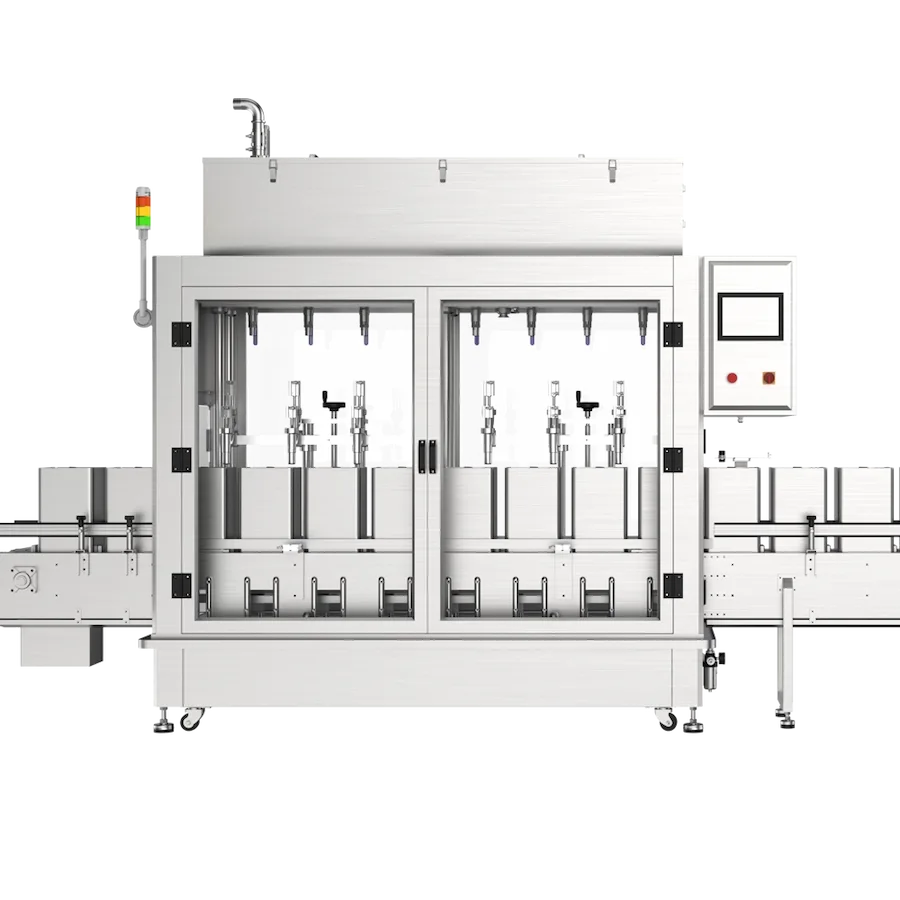
Filling Machine – Dispenses the product (liquid, cream or powder) into each bottle. Filling technology varies by product: volumetric piston fillers, flow-meters, or vacuum fillers are common. Multi-head rotary fillers can handle hundreds to thousands of bottles per hour. (Yundu’s Bottle Liquid Filling Machine is an example.)
Capping/Sealing Station – Applies caps, lids or crowns to seal bottles. Automatic cappers (screw-cap heads, crown cappers, or induction sealers) ensure a tight seal on every container.
Labeling Machine – Applies printed labels or sleeves to each bottle for branding and compliance. Labelers can handle wrap-around labels, front-and-back labels, or shrink sleeves at high speed.
Inspection & Coding – Sensors and cameras check fill levels, cap tightness, and label accuracy. Ink-jet or laser coders mark each bottle with lot codes or expiration dates for traceability.
Conveyors and Packaging – Conveyor belts move bottles smoothly between stations. At the end, filled bottles may be shrink-wrapped in trays, packed into cartons, or palletized for shipping.
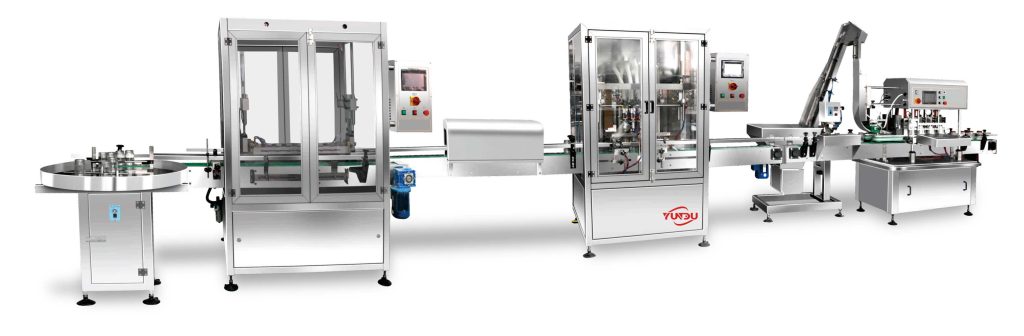
Each component is carefully synchronized in a turnkey line to ensure a smooth flow and high output. By integrating all machines as a single system, these lines achieve greater efficiency and consistency than disconnected individual machines.
Types of Bottling Lines and Applications
Bottling lines are tailored to specific products and industries. Key categories include:
Beverage and Water Filling Lines
Plants bottling water, sodas or juices use highly automated 3-in-1 rotary lines (rinser–filler–capper) for continuous bottling. For example, Neptune Machinery describes a 3-in-1 bottle water filling machine that can adjust to round or square bottles from 300 ml up to 2 L, with 8 rinsing heads, 8 fillers, and 3 cappers in one compact unit. Typical throughput might be ~2,000 bottles/hour for 500–600 ml bottles or around 1,200 BPH for 1.5–2 L bottles. Upstream, water treatment (filtration, UV) ensures quality. After filling, these lines proceed with capping, labeling and often inline packing (shrink-wrapping, case-packing) to finish each bottle.
Beer Canning and Brewing Lines
Breweries use lines designed for beer’s needs. Beer can filling machines often use counter-pressure or vacuum filling to preserve carbonation. A full brewery canning line may include a depalletizer, can rinser, filling machine, capper, and labeler. Many craft brewers now favor cans, since cans lock in flavor and block light (helping beer stay fresh). Small craft lines might output only a few hundred cans per hour, whereas large industrial lines can run thousands per hour. These lines may also incorporate CO₂ purging at fill time to minimize oxygen pickup. Bottle-filled beer lines use similar equipment but may omit the can-specific rinser. In all cases, turnkey canning/bottling lines help brewers maintain consistency and speed.
Wine Bottling Lines
Wine bottling lines share many features with beverage lines, but emphasize gentle handling and oxygen control. Winemakers often flush bottles with an inert gas (nitrogen or CO₂) before filling to minimize oxygen pickup, and may inject a small inert headspace before sealing. These lines include vacuum or gravity fillers, as well as corking or screw-capping machines. Because wine quality is critical, line speeds are usually moderate (hundreds of bottles per hour) and may include additional filtration or inspection steps. After sealing, bottles are labeled and case-packed just like other turnkey lines.
Pharmaceutical Vial Filling Lines
Pharmaceutical lines are very specialized. A vial filling line is an aseptic system for filling, capping and labeling small glass vials (typically 1–100 ml). These lines are used for vaccines, biologics, and other high-value liquids. Key requirements include extremely high accuracy (often ±0.5% fill precision) and sterility (often via isolators or laminar flow hoods). Throughputs are lower – on the order of 25–100 vials per minute – and vials may be sealed with rubber stoppers and crimped caps. Many systems also include vacuum or inert-gas backfilling for certain injectable products. A turnkey vial line has high-precision pumps, sterile components, and rigorous quality checks to meet strict pharmaceutical standards.
Buying and Maintaining Filling Lines
When sourcing a bottling line, match the line size to your needs. Search terms like “bottling line for sale” or “bottle filling machine for sale” can yield anything from small tabletop fillers to multi-head industrial systems. As one guide notes, a “full bottling line for sale” usually implies an industrial setup handling hundreds to thousands of bottles per hour. In contrast, a very small brewer making a few hundred bottles a day might use a compact semi-automatic filler. Focus on total throughput and long-term value, not just upfront price.
New vs. Used Equipment: Used bottling equipment can lower the investment. For example, surplus listings show used lines from major brands like Krones, Hoppmann, and others. However, buyers should carefully inspect any used line to ensure it’s in good condition and compatible with their bottles. Certified refurbished systems from reputable vendors offer a middle ground: lower cost but with warranty and support.
Compliance and Support: Ensure your line meets industry regulations (FDA, CE, GMP, etc.) and that spare parts are available. Good turnkey suppliers provide operator training, preventive maintenance plans, and technical support. Routine tasks (like cleaning CIP circuits or calibrating sensors) should be straightforward with proper guidance. Investing in training and support up front can save money by avoiding downtime and extending the line’s life.
llogo-e1743643883897.webp)