What is a Non-Standard Automation Production Line?

Table of Contents

Non-standard automation production lines are customized manufacturing systems built to meet unique process requirements. Unlike mass-produced “standard” production lines, these setups use special machinery and control logic tailored to a particular product or workflow. In practice, a non-standard line is assembled from various industrial modules (motors, actuators, conveyors, sensors, etc.) and programmed according to the client’s specifications. For example, a custom conveyor-robot assembly line might be built to handle a uniquely shaped part or a very small production run. Such systems are highly flexible and adaptable, integrating advanced machinery, electronics and control software to fit an exact task. In essence, “non-standard” means the production line isn’t one-size-fits-all – it is tailor-made for a company’s specific product geometry, quality targets and space constraints.

What is a Non-Standard Automation Production Line

Standard vs. Non-Standard Production Lines

Standard automated lines are built from interchangeable, off-the-shelf components and follow uniform industry processes. They are optimized for large-volume, repetitive production with minimal variation, using fixed fixtures and defined SOPs. This approach yields high throughput and consistency, but is rigid: if product design changes, a standard line often must be scrapped or completely retooled. In contrast, non-standard lines emphasize customization and flexibility. They are engineered case-by-case, with no fixed blueprint. Non-standard equipment is “customized according to customer needs” and not sold as a generic product. Because each customer’s product and process are different, every non-standard line is unique. Liyang Kunli explains: “A non-standard automated production line is an automated production line that is custom designed and manufactured according to specific product requirements”. This specialization makes non-standard lines far more adaptable: by adding, removing or reconfiguring modules, the line can be quickly adjusted for different product variants.

Key differences include:

Flexibility

Non-standard lines can accommodate design changes, new products, or multiple product types with minor reprogramming or module swaps. Standard lines have limited flexibility once built.

Customization

Every aspect of a non-standard line (mechanical design, sequence, control software) is tailored. Standard lines use uniform designs.

Speed and Efficiency

For high-volume stable products, standard lines may run faster initially. However, in varied or changing markets, non-standard lines avoid downtime and scrapping associated with redesign.

Investment and Risk

Non-standard systems often require higher upfront engineering time and cost (complex design, prototyping). Standard lines spread investment over large volumes, so per-unit cost may be lower in stable scenarios.

In summary, standard automation excels at mass production of unchanged goods, while non-standard automation is the solution for unique or evolving production needs.

Characteristics of Non-Standard Automation

By design, non-standard automation equipment shares several defining traits:

  • High Customization: Each machine is made-to-order. The core feature of non-standard automation is its tailoring to one customer’s process. Components, motion sequences and control logic are chosen to fit specific product shapes, tolerances and assembly steps. For example, if a product needs a special gripping mechanism, the automation designer will incorporate a custom end-effector instead of a generic robot arm.

  • Modular and Expandable Design: Many non-standard lines use modular architecture. Units like conveyors, robot stations, vision inspection stations, or specialized tool heads are built as separate modules. These can be added or rearranged as needs change. This modular approach allows future upgrades (e.g. add an extra testing station) and easier maintenance.

  • Advanced Integration: Such lines integrate multiple technologies: mechanical handling (belts, pneumatic shuttles), robotic motion (servo-driven arms), sensors (vision cameras, lasers), and computerized control (PLCs, HMIs, software). The automation system “integrates advanced machinery, electronics, control and information technology” into a cohesive whole. Data from sensors is fed to PLCs or PCs to monitor quality and drive actuators in real time, achieving precise automatic operation.

  • Professional Engineering: Building a non-standard line is complex. There is no “one-size-fits-all” template, so engineers must often create new designs from scratch. This requires expertise in areas like mechanical CAD, electrical design, and automation programming. The process often involves prototyping and simulation. The Shenchong guide notes that non-standard line manufacturing is complex due to low blank precision and high machining allowances.

  • Customization of Control Logic: The control software (usually PLC or embedded controllers) is programmed for the unique sequence of steps. The logic might include special timing, quality checks, or servo motion profiles specific to the product. This software is also typically proprietary to the line.

  • Size and Scope: Non-standard lines can range from a single automated machine to an entire production cell. Some are compact (e.g. a single servo-driven assembly cell), others are sprawling multi-station lines. What defines them is custom scope rather than scale.

In essence, a non-standard line is highly flexible and personalized to its task. It can often be reconfigured: for example, the line may “add, delete or change certain aspects of the production process” to handle different products.

Components and Technology

Non-standard automation lines use many of the same building blocks as standard automation, but arranged uniquely:

Mechanical Modules

This includes custom-designed frames, rotary tables, conveyors, indexing mechanisms and fixtures. Each is often tailor-made. For instance, a custom conveyor might be shaped to fit the product geometry.

Robotics and Actuators

Industrial robots (articulated arms, gantry robots) or custom manipulators execute operations (pick-and-place, welding, assembly). If a product is irregular, a specialized robot with custom end-effector is used. Servo motors and actuators provide precise motion control.

Sensors and Vision

Cameras, photoelectric sensors, encoders and force sensors are strategically placed to verify correct part positioning, measure dimensions, and ensure quality. For example, a vision system can inspect a component mid-line. These feed back to the control system to make decisions (reject a bad part, adjust a position, etc.).

Control System

The “brain” is typically a PLC (Programmable Logic Controller) or industrial PC that coordinates timing and logic. Custom logic handles unusual sequences. An HMI (Human-Machine Interface) panel may be added for operators to monitor status or switch modes.

Control System

Pneumatics/Hydraulics

Custom pneumatic cylinders or hydraulic units may be added for specific motions (clamping, stamping, etc.), chosen by the machine designer to suit the product’s needs.

Software and Networking

Often, a SCADA or MES interface is used to track production data. Non-standard lines are increasingly connected to plant networks. They may incorporate IoT modules or smart sensors per Industry 4.0 trends.

Safety Systems

Because layouts can be unique, special guarding, light curtains, interlocks, and safety PLC logic are designed to protect workers.

Technically speaking, designing a non-standard line means selecting each of these elements for the specific application. For instance, if high positional accuracy is needed, high-end servo drives and encoders will be chosen. If product shapes vary, flexible fixturing or quick-change tooling might be implemented. As GST Technology notes, non-standard automation is “designed and manufactured according to the specific needs and production processes of customers”, which inherently involves a broad engineering effort.

Advantages of Non-Standard Automation

The main benefits of a non-standard automated production line stem from its flexibility and optimization:

  • Perfect Fit to Requirements: Every element is tailored, so the line can handle unique product shapes, sizes, or assembly steps. This maximizes efficiency for that product. For example, a machine can integrate an exact number of stations needed with minimal downtime between steps.

  • High Customization and Flexibility: As GST explains, one advantage is a “high degree of customization”. The line’s structure and functions can be changed when needed, allowing adaptation to different products or new versions. This means factories can respond to changing market demands without scrapping equipment.

  • Improved Efficiency and Productivity: By automating tailored workflows, companies replace labor-intensive tasks with precise machines. GST notes automation lines significantly improve production speed and reduce errors. For instance, repetitive tasks done by robots run faster and more consistently than by hand.

  • Enhanced Quality Control: Custom lines often include inspection steps built in. A standardized line might not catch unique defects in a new product, but a custom line can have sensors specifically aligned to check critical dimensions or features, boosting yield and consistency.

  • Competitive Advantage: Companies gain unique capabilities. A manufacturing line that others don’t have allows producing niche products or higher-mix outputs. GST points out that such customized solutions “help companies achieve unique production advantages and improve market competitiveness”.

  • Scalability for Small Batches: In markets with many SKUs or short runs, a custom line can switch between tasks more easily. It can be scaled up/down or modified faster than building a whole new standard line for each product.

  • Data Collection and Control: Non-standard lines can be equipped with advanced monitoring (PLCs, sensors) to collect data on key parameters in real time. This enables tighter process control, predictive maintenance, and continuous improvement.

As one review explains, non-standard automation “offers a plethora of benefits” including tailored solutions, streamlined operations, and scalability. For example, an electronics manufacturer could automate test-and-packaging precisely for their own PCB shape, squeezing out time and error reductions that a generic machine couldn’t achieve.

Drawbacks and Challenges

Custom solutions do have trade-offs:

  • Higher Up-Front Cost: Designing and building a one-off system requires more engineering effort. This raises the initial investment. As Shenchong notes, “the production cost of non-standard equipment is high”. Engineering hours, custom parts, and complex programming all add cost.
  • Longer Development Time: A custom line may take longer to design and commission than deploying a standard solution. Each component might be prototyped or finely tuned. The “complexity” of non-standard lines means no pre-made blueprint is available.
  • Technical Risk: Because each system is unique, there’s less room for proven designs. Unexpected integration issues can arise (timing mismatches, mechanical interferences). Companies rely heavily on experienced designers.
  • Maintenance Complexity: Custom machines may be harder to maintain, especially if only specialized technicians know their setup. Spare parts may not be off-the-shelf.
  • Less Reusability: If a company’s product changes completely, the custom line may need major rework. While more flexible than fixed lines, extreme changes can still require new engineering.
  • Resource Requirement: It takes skilled automation engineers and often expensive manufacturing equipment (CNC machining, laser cutting, etc.) to produce precise custom machines.

However, companies planning a non-standard line usually consider these challenges upfront. The benefits in flexibility and efficiency often justify the investment, especially in fast-changing industries.

Industry Applications

Non-standard automation lines appear wherever products or processes are highly specialized. Typical industries include:

  • Packaging and Printing: As demand grows for varied package shapes/sizes, custom conveyors, feeders, and cartoners are built to handle mixed products. Food, beverage, cosmetics and medical packaging often use tailored lines (e.g., machines that can switch between candy sizes without manual retooling).

  • Electronics Assembly: PCBs, sensors, small devices often need custom feeders and pick-and-place robots. Unique product geometries or cleanroom requirements lead to custom line setups.

  • Automotive: Many auto parts (engine components, electronics, trim) are assembled on non-standard lines. For example, welding fixtures and robot cells are custom-made for a car body’s geometry.

  • Medical/Pharmaceutical: Here even slight contamination risk means custom enclosed systems, sterile material handling, or precision filling machines – often one-off.

  • New Energy (Batteries, PV): Battery cell assembly, module handling etc. are highly specialized, requiring unique automation.

  • Logistics and Warehousing: Automated storage/retrieval systems can be custom-designed for a warehouse layout.

  • Aerospace: Low-volume, high-precision parts are handled on specialized equipment.

The Hehui article emphasizes that non-standard equipment spans “almost all industries” from automotive to electronics, medical, aerospace, etc.. Shenchong specifically lists “packaging, printing, textile and assembly” as main industries for such equipment.

Each industry example requires different solutions. For instance, in electronics, a line might integrate delicate conveyor belts and vacuum pickers, while in food packaging a line might include sanitation-grade conveyors and fill/seal stations. The core theme is the same: custom-engineer each element to the product’s needs.

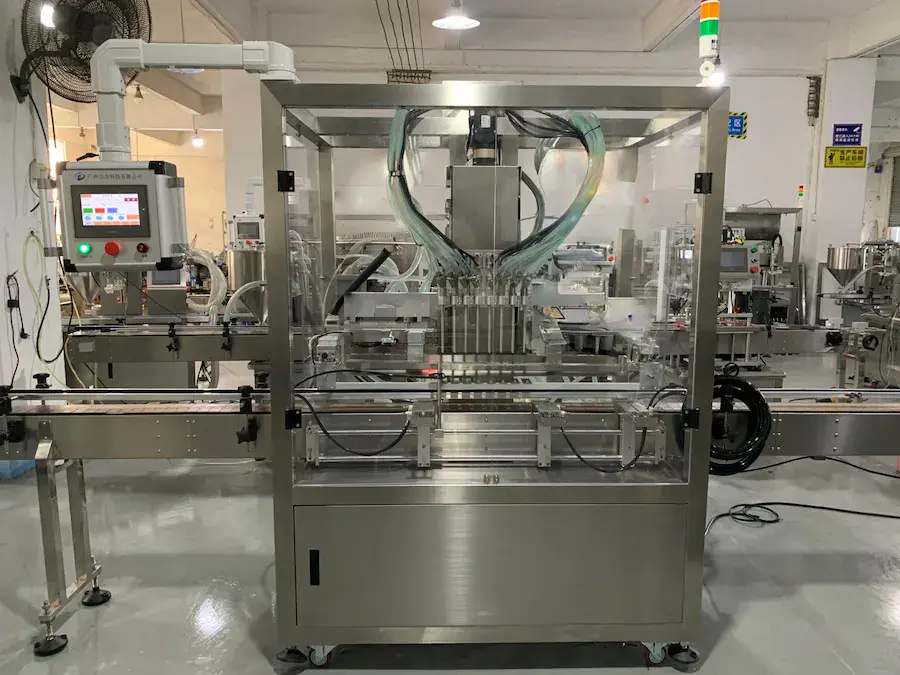
Packaging Machinery Example

A custom automated packaging line for beverage bottles.

In the packaging machinery industry, non-standard automation is especially common. Here, product variety is high: companies package items of all shapes and sizes (snacks, beverages, pharmaceuticals, etc.). Standard machines often cannot switch between different package dimensions without major downtime. A non-standard packaging line is custom-built so conveyors, feeders, and robotic arms all match the exact product specifications.

For example, Win-Win Packaging explains that non-standard packaging machines are “custom-produced according to the specific needs and requirements of customers. Unlike traditional standard machines, [they] can be adjusted and modified according to the shape, size, and special requirements of different products”. This means a single line can handle multiple product shapes by changing tooling or adjusting guides, which standard machines can’t do easily.

One real case (from a food industry report) describes a snack manufacturer facing exactly this issue: their mix of candies and biscuits, each in various sizes, overloaded their standard packaging equipment. By investing in a non-standard line, engineers created a bespoke packaging solution that could automatically detect the product type and adjust the conveyors, fill valves, and seal jaws accordingly. The result was seamless multi-size operation and a 30% efficiency gain.

Generally in packaging:

  • Custom palletizing robots might be added to arrange boxes in patterns.
  • Special label applicators are set up for each product’s label size.
  • Variable-speed belts and vision-guided cameras ensure misaligned items are corrected automatically.
  • The entire sequence (pick, fill, cap, label, seal) is programmed to the exact container design.

In short, non-standard packaging lines allow manufacturers to automate even irregular or low-volume packaging processes that off-the-shelf machines could not handle. They also reduce manual changeovers, improving throughput and reducing errors. As one industry news piece notes, non-standard packaging machines “can quickly adapt to the packaging needs of different products, improving packaging efficiency”, which is a huge advantage in a competitive market.

Implementation and Considerations

When creating a non-standard line, engineers typically follow these steps:

  1. Requirement Analysis: Deeply understand product specs (size, weight, material) and process steps. This includes growth plans (future products) to design flexibility.

  2. Concept Design: Lay out the sequence of operations (stations). Choose modular components and technologies (robots, conveyances).

  3. Detailed Engineering: Develop mechanical designs (fixtures, frames), electrical schematics (PLC wiring), and software logic.

  4. Prototyping & Simulation: For complex motions (e.g. multi-axis robot path), use virtual models. Sometimes a prototype station is built first.

  5. Integration & Testing: Assemble the line and test with real products. Fine-tune timing, sensor positions, and control code.

  6. Training & Handover: Teach operators how to run the line, change tooling, and perform maintenance.

Key considerations include ensuring seamless integration with existing equipment. When expanding an automated line, designers use standardized interfaces and protocols (ethernet, common safety bus, etc.) to ease integration. Also, attention is paid to safety (guards, PLC-based interlocks) and maintainability (easily accessible parts).

Because custom lines often evolve, companies embrace modular design and human-machine collaboration. Modern non-standard lines may include cobots (collaborative robots) that work alongside humans for flexible tasks. GST Technology foresees trends like modular equipment, IoT connectivity, and AI-driven adjustments.

Conclusion

A non-standard automation production line is essentially a bespoke manufacturing system – custom engineered from the ground up to meet specific product and process requirements. It contrasts with generic automated lines by offering unmatched flexibility, customization and adaptability. These lines are complex and require careful design, but they let companies automate tasks that off-the-shelf machines can’t handle. As a result, businesses dealing with specialized products or frequent changes can achieve higher efficiency, better quality, and a competitive edge.

In today’s fast-evolving markets (Industry 4.0 era), non-standard automation provides the agility needed to quickly switch between products or upgrade processes. Whether in packaging machinery, electronics, automotive or pharmaceuticals, tailor-made automated lines are becoming an essential tool for innovation and productivity.

Non-Standard Automation Production Line FAQ

Transparency is the cornerstone of our Yundu team. That’s why below, you can find the most common questions and answers we receive surrounding our non-standard automation production line.

A non‑standard automation production line is a custom‑designed manufacturing system tailored to a specific product’s requirements, integrating bespoke machinery, control logic, and layout rather than using off‑the‑shelf, one‑size‑fits‑all components.

Standard automation uses uniform, mass‑produced equipment optimized for high‑volume, unchanging products. Non‑standard automation is engineered case‑by‑case for flexibility, able to handle unique product geometries and frequent changeovers.

  • Tailored fit to product specs
  • High flexibility for product changes
  • Improved quality control via custom inspection
  • Scalability for small or varied production runs
  • Competitive advantage through unique capabilities
  • Higher upfront engineering costs
  • Longer development and commissioning times
  • Increased technical risk and integration complexity
  • Potentially specialized maintenance and spare‑parts needs

A standard example is a car assembly line where robots weld, paint, and install components in a fixed sequence using identical fixtures and robots optimized for high throughput.

In Computer Integrated Manufacturing (CIM), an automated production line is a networked system of machines, robots, and computers that seamlessly share data and control signals to optimize production flow with minimal human intervention.

Pros: Higher throughput, consistent quality, reduced labor costs, improved safety.
Cons: Large initial investment, inflexibility for product changes, need for specialized skills, potential job displacement.

  1. Fixed Automation: Dedicated equipment for a single product.
  2. Programmable Automation: Equipment reprogrammable for batch changes.
  3. Flexible Automation: Equipment that can switch between products with minimal downtime.
  4. Integrated Automation: Complete factory‑wide integration of machinery, software, and data.

Industries with highly specialized or variable products such as packaging machinery, electronics assembly, automotive, medical devices, aerospace, and new energy (e.g., battery manufacturing).

  1. Requirement analysis
  2. Conceptual layout and module selection
  3. Detailed mechanical, electrical, and software design
  4. Prototyping and simulation
  5. Integration, testing, and debugging
  6. Operator training and handover
Share The Post Now:
Picture of Hey there, I’m Daisy

Hey there, I’m Daisy

I’m the Sales manager of Yundu. We have been helping manufacturing industries increase their productivity and capacity with our advanced filling machines for over 20 years.
Have questions? Reach out to us, and we will provide you with a perfect solution.

Related Articles

Get Instant Quote

If you’d prefer, a representative from Yundu can contact you directly. Please provide the information below and a member of our sales team will contact you shortly. * fields are required.