 English
 Arabic
 Indonesian
 Vietnamese
 Malay
 Thai
 Korean
 Russian
 French
 Italian
 Japanese
 Portuguese
 Turkish
 Spanish
Wet wipes have become essential products in everyday life, serving personal hygiene, healthcare, household cleaning, food service, automotive maintenance, and many other industries.
As global demand for convenient disposable hygiene products continues to develop, more manufacturers are investing in automated wet wipes production equipment to improve efficiency and expand their product ranges.

However, producing and packaging wet wipes involves more than simply folding nonwoven fabric and placing it inside a pouch. A complete manufacturing process may include fabric unwinding, slitting, folding, liquid preparation, moisture application, cutting, counting, stacking, pouch forming, heat sealing, and finished-product handling.
Choosing the right wet wipe packaging machine is therefore an important decision for manufacturers planning to establish a new factory or upgrade an existing production facility.
This guide explains the different types of wet wipe packaging machines, their applications, packaging formats, production processes, and key purchasing considerations. It also introduces Yundu’s automatic wet wipes machinery solutions for both individual sachets and multi-pack products.
What Is a Wet Wipe Packaging Machine?

A wet wipe packaging machine is specialized equipment designed to package pre-moistened wipes into individual sachets, resealable pouches, or other dispensing containers.
Depending on the machine configuration, it can integrate several production functions, including automatic folding, liquid dosing, cutting, counting, stacking, film feeding, pouch forming, and heat sealing.

Non-woven fabric spray humidification for wet wipe machines
Some machines are designed specifically for individually wrapped wipes, while others process multiple sheets into larger retail packages.

Non-woven fabric slitting for wet wipe machines
For industrial manufacturers, wet wipe packaging equipment is usually part of a broader wet wipes converting and manufacturing system.

Non-woven fabric counting and stacking for wet wipe machines
A complete production setup may include:
Nonwoven fabric unwinding and slitting equipment
Automatic wet wipe folding systems
Liquid mixing and circulation tanks
Automatic cutting and counting units
Wet wipe pouch packaging machines
Resealable label or flip-top lid application systems
The appropriate configuration depends on the target products, packaging dimensions, required production capacity, and available factory utilities.
For buyers: Before requesting a quotation, define whether you intend to produce single-use sachets, small travel packs, or large multi-sheet wet wipe packages. This decision will determine the type of automatic wet wipes packaging machine you need.
Inline Quality Inspection:

If your compliance standards require a metal detector or foreign-object inspection machine, Yundu can also supply and integrate automated contaminant-detection and checkweighing units with automatic rejecters directly between the flow wrapper and downstream packing.
What Types of Wet Wipes Can Be Produced?
Wet wipes are used across many industries, and each application has different requirements for fabric materials, liquid formulations, folding patterns, and packaging structures.
Understanding the target products is the first step in selecting suitable wet wipes manufacturing machinery.
1. Baby Wipes

Baby wipes are among the most common products manufactured on automatic wet wipes production lines.
They typically use soft spunlace nonwoven fabric and gentle cleansing formulations. Common retail formats include 40-, 60-, 80-, and 120-sheet packages.
These products usually require resealable adhesive labels or rigid plastic flip-top lids to maintain moisture after opening.
Recommended equipment: A multi-lane baby wipes packaging machine with automatic folding, liquid saturation, cutting, counting, stacking, and pouch packaging functions.
2. Facial and Personal Care Wipes
Facial cleansing wipes, makeup remover wipes, and personal hygiene wipes are widely sold through supermarkets, pharmacies, and cosmetic retailers.
They are commonly packed in small travel pouches or medium-sized resealable packages containing approximately 10–30 sheets.
Recommended equipment: An automatic wet tissue packaging machine with adjustable folding, precise liquid application, and flexible pouch dimensions.
3. Alcohol and Disinfectant Wipes
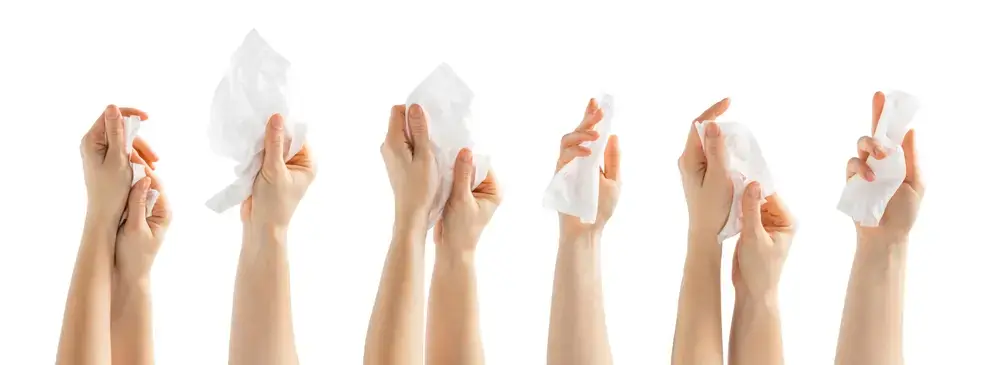
Alcohol pads, disinfectant wipes, and medical cleaning wipes are often supplied in individually wrapped sachets or larger multi-sheet packs.
Single-use products require accurate liquid dosing and reliable individual seals. Packaging film must be selected according to the formulation and required barrier performance.
Recommended equipment: A single-sachet wet wipe packaging machine or a dedicated multi-pack line, depending on the final product format.
4. Household Cleaning Wipes

Household wipes are designed for cleaning kitchen counters, bathrooms, furniture, appliances, and other surfaces.
They are commonly supplied in 40–120-sheet resealable pouches.
Manufacturers should consider substrate strength, cleaning liquid compatibility, and packaging moisture retention when selecting machinery.
Recommended equipment: An automatic multi-lane wet wipes manufacturing and packaging line.
5. Pet Care Wipes
Pet wipes are used for grooming, paw cleaning, ear cleaning, and general hygiene.
Their formulations and substrate requirements vary according to the intended application. Small and medium-sized resealable pouches are common packaging choices.
Recommended equipment: A flexible wet wipes packing machine with adjustable package sizes and compatible liquid application systems.
6. Industrial and Automotive Cleaning Wipes
Industrial cleaning wipes are used in workshops, factories, automotive maintenance facilities, and manufacturing plants.
They may use durable substrates and specialized cleaning or degreasing formulations to remove oil, dirt, and grime.
Recommended equipment: Industrial wet wipe packaging equipment configured for the selected fabric, liquid formulation, and packaging format.
7. Hospitality and Food Service Wipes

Restaurants, hotels, airlines, and catering companies often purchase individually wrapped hand wipes and refreshing towels.
These products are generally supplied in compact sachets for convenient single-use distribution.
Recommended equipment: A high-speed automatic wet wipe sachet packing machine with precise liquid dosing and individual heat sealing.
What Types of Wet Wipe Packaging Machines Are Available?
Different wet wipe products require different machine structures. Manufacturers should select their equipment according to the number of sheets per package, final pouch dimensions, production capacity, and required automation level.
The following are the main types of wet wipe packaging equipment available for commercial production.
1. Single Sachet Wet Wipe Packaging Machine
A single sachet wet wipe packaging machine is designed to produce individually wrapped wipes.
Typical applications include alcohol pads, eyeglass cleaning wipes, restaurant hand wipes, cosmetic samples, and other disposable cleaning products.
The machine generally integrates:
Automatic nonwoven fabric feeding
Vertical and horizontal folding
Precision liquid dosing
Packaging film unwinding
Sachet forming and heat sealing
Individual cutting and discharge
Compared with multi-pack equipment, single-sachet machines focus on compact packaging, accurate dosing, and consistent individual sealing.
For manufacturers targeting hotels, restaurants, healthcare suppliers, or optical cleaning markets, this equipment can provide a dedicated production solution.
Explore: Yundu-800 Automatic Wet Wipe Sachet Packaging Machine
2. Multi-Lane Wet Wipes Packaging Machine
A multi-lane wet wipes packaging machine is designed for high-volume production of products containing multiple sheets.
It is commonly used for baby wipes, household cleaning wipes, pet wipes, and personal care wipes.
Multiple fabric lanes operate simultaneously, allowing the machine to process a large number of sheets per minute.
A typical configuration includes:
Jumbo nonwoven fabric unwinding
Multi-lane fabric slitting
Automatic N-fold or Z-fold processing
Liquid circulation and saturation
Cutting and sheet counting
Automatic stacking
Pouch forming and sealing
A 12-lane production line is particularly suitable for manufacturers targeting large retail orders and private-label wet wipe products.

Water-treatment-system
The final production capacity depends on wipe dimensions, sheet count, operating speed, and machine configuration.
3. Baby Wipes Packaging Machine
A baby wipes packaging machine is designed for manufacturing and packaging multi-sheet baby wipes.
Most commercial packages contain 40–120 sheets and feature resealable adhesive labels or rigid flip-top lids.
The equipment should provide stable folding, uniform moisture distribution, accurate sheet counting, and reliable pouch sealing.
Important features may include:
Adjustable bag forming systems
Automatic gusseting devices
Photoelectric eye-mark tracking
Resealable label application
Flip-top lid application options
PLC control and touchscreen operation
For manufacturers planning to supply supermarkets, distributors, and baby-care brands, a multi-lane baby wipes production line can provide an efficient manufacturing solution.
4. Wet Tissue Flow Wrapping Machine
Flow wrapping is another common packaging method for wet wipes.
The machine uses a continuous roll of laminated film to form a pouch around the product. The package is sealed along the longitudinal and transverse directions.
Flow-wrap systems are commonly used for flat wet wipe packs and other flexible packaging applications.
Depending on the equipment design, additional functions can include printed-film registration, date coding, cutting, and resealable label application.
Important: A conventional flow wrapper is not necessarily a complete wet wipes manufacturing machine. Buyers should confirm whether the quoted equipment includes fabric folding, liquid application, and counting systems or only the final packaging section.
What Are the Different Wet Wipe Packaging Formats?
Choosing the correct packaging structure is important for product protection, retail presentation, and machine compatibility.
Most manufacturers work with four major packaging formats.
Three-Side and Four-Side Seal Sachets
These flat sachets are commonly used for individually wrapped wipes.
Laminated films are sealed around a single wipe to create a compact package.
Three-side or four-side sealing structures can be selected according to product dimensions and machine design.
Flat Flow-Wrap Pouches
Flat pouches generally contain 5–30 sheets and are popular for travel wipes and compact personal-care products.
They commonly feature a fin seal, end seals, and a resealable adhesive sticker covering the dispensing opening.
Gusseted Multi-Pack Pouches
Gusseted pouches are widely used for baby wipes and household cleaning wipes.
Side gussets allow the package to expand into a rectangular shape, accommodating larger sheet quantities and optional rigid flip-top lids.
A suitable multi-lane wet wipes packing machine should provide stable bag forming and accurate gusset positioning.
Canister and Tub Packaging
Canister wipes are often used in industrial cleaning, healthcare, and household applications.
Depending on the dispensing design, they may contain stacked wipes or continuous rolls.
Refill pouches are another option for consumers who reuse rigid containers.
Purchasing tip: Confirm your intended packaging format before choosing a machine. Film width, seal structure, pouch dimensions, and dispensing accessories can all affect machine design and production cost.
How Does an Automatic Wet Wipes Production Line Work?
A complete wet wipes manufacturing line combines several mechanical and fluid-handling processes.
The main objective is to produce consistently folded, evenly moistened, accurately counted, and properly sealed wet wipes.
Step 1: Water Treatment and Liquid Preparation
Water treatment equipment prepares the water required for the wet wipe formulation.
Reverse osmosis (RO) systems are commonly used as part of the purification process. The treated water is then mixed with the required cleansing lotion or disinfectant formulation in stainless-steel tanks.
Tank capacity and mixing systems should be selected according to daily production requirements.
Step 2: Nonwoven Fabric Unwinding and Slitting
Large rolls of spunlace nonwoven fabric are installed on the unwinding system.
The machine controls fabric tension and feeds the material through rotary slitting devices to obtain the required width for each production lane.
Stable tension control helps reduce wrinkles and maintains consistent fabric feeding.
Step 3: Automatic Folding
The nonwoven fabric passes through folding mechanisms to create the required N-fold, Z-fold, or other specified folding patterns.
The folding arrangement depends on the final wipe dimensions and packaging configuration.
Single-sachet machines use compact folding mechanisms to prepare individual wipes, while multi-lane equipment processes multiple fabric lanes for larger packages.
Step 4: Liquid Dosing and Saturation
The liquid application system distributes the prepared solution across the fabric.
Multi-pack production lines generally use circulation tanks and metering pumps to maintain consistent moisture distribution.
Single-sachet machines use precision dosing systems to control the liquid quantity applied to each individual wipe.
Step 5: Cutting and Counting
The folded and moistened fabric is cut into individual sheets.
For multi-pack production, automatic counting and stacking systems arrange the wipes into predetermined quantities, such as 40, 60, 80, or 120 sheets.
Accurate counting helps maintain consistent package specifications and reduce material waste.
Step 6: Pouch Forming and Heat Sealing
The wipes are transferred to the packaging section, where laminated film is formed around the product.
Depending on the machine configuration, this section can include:
Automatic film unwinding
Photoelectric eye-mark tracking
Adjustable bag forming
Side gusset formation
Longitudinal heat sealing
Transverse heat sealing
Cutting and pouch separation
Reliable sealing is essential for preventing leakage and maintaining product moisture during storage and transportation.
Step 7: Labeling, Coding, and Finished Product Handling
Additional equipment can punch dispensing openings, apply resealable labels, install flip-top lids, and print batch numbers or production dates.
Finished packages can then be transferred to conveyors, automatic case packers, carton sealers, or palletizing systems.
Yundu Wet Wipe Packaging Machine Solutions
As a wet wipes machinery manufacturer in China, Yundu provides equipment solutions for both individual sachet packaging and multi-sheet wet wipes production.
Different machine configurations are available to meet the production requirements of manufacturers entering personal care, healthcare, household cleaning, and hospitality markets.
Yundu-800B Single Sachet Wet Wipe Packaging Machine
The Yundu-800 is designed for individual wet wipe sachets, including alcohol pads, eyeglass cleaning wipes, and other single-use cleaning products.

It integrates automatic folding, liquid dosing, packaging film feeding, and individual sachet sealing.
Key features:
Production speed: approximately 100–140 bags/min
Liquid dosing range: 0–5 ml, with stated accuracy of ±0.1 ml
Vertical folding: maximum 10 folds
Horizontal folding: 2-fold or 3–4-fold configurations
Customizable sachet dimensions
Right-angle or rounded-corner packaging options
PLC and servo control system
Reference technical specifications:
| Parameter | Yundu-800B |
|---|---|
| Applicable Fabric | Spunlace, spunbond, cotton, air-laid, and wet-strength paper |
| Fabric Basis Weight | 20–105 g/m² |
| Maximum Film Width | 300 mm |
| Film Core Diameter | 70–75 mm |
| Film Roll Outer Diameter | 350–400 mm, maximum 460 mm |
| Power Supply | 220V, 2-phase, 50/60Hz |
| Total Power | 10 kW (right-angle) / 11.15 kW (rounded) |
| Air Pressure | 0.6–1.0 MPa |
| Air Consumption | 0.5–0.8 m³/min |
| Machine Weight | Approximately 1,100 kg |
| Machine Dimensions | 3,800 × 2,600 × 1,800 mm |
The Yundu-800B is suitable for manufacturers who want to establish a dedicated individual sachet production line.
Yundu 12-Lane Wet Wipes Production Line
For manufacturers producing baby wipes, household cleaning wipes, pet wipes, and other multi-sheet products, Yundu offers a 12-lane wet wipes production line.
The system integrates multiple fabric lanes with folding, liquid saturation, cutting, counting, stacking, and automatic pouch packaging functions.
Key features:
12-lane production configuration
Suitable for 40–120-sheet packages
N-fold / Z-fold processing
Dual liquid circulation tanks
Automatic cutting and stacking
Adjustable bag former
Optional gusseting and eye-mark tracking
Optional date coding, punching, and labeling
PLC control with color touchscreen HMI
Reference technical specifications:
| Parameter | 12-Lane Production Line |
|---|---|
| Target Products | Baby wipes, household wipes, pet wipes, disinfection wipes |
| Production Capacity | Approximately 2,400–3,600 sheets/min |
| Pack Speed | Approximately 30–40 packs/min, depending on pack configuration |
| Folding Pattern | N-fold / Z-fold |
| Unfolded Wipe Size | 150–230 × 150–250 mm |
| Folded Wipe Size | 150–230 × 90–120 mm |
| Packaging Dimensions | 180–300 × 90–120 × 30–80 mm |
| Fabric Material | Spunlace nonwoven |
| Fabric Basis Weight | 35–80 g/m² |
| Packaging Film | Heat-sealable OPP/PE or PET/PE |
| Fabric Roll Width | 1,000–1,500 mm |
| Fabric Roll Diameter | Approximately 1,000 mm |
| Liquid System | Dual 200 L tanks |
| Power Supply | 380V, 50Hz |
| Total Power | 25 kW |
| Machine Weight | Approximately 9,000 kg |
| Machine Dimensions | 18,330 × 3,380 × 2,350 mm |
Note: These are reference specifications. Actual speed and applicable dimensions depend on the product design, packaging requirements, material characteristics, and final machine configuration. Please confirm the technical details with Yundu before ordering.
Single Sachet vs. Multi-Lane Wet Wipes Production Line: Which Should You Buy?
The choice between an individual sachet machine and a multi-lane wet wipes production line depends mainly on your target products and business model.
| Comparison | Single Sachet Machine | Multi-Lane Production Line |
|---|---|---|
| Typical Products | Alcohol pads, lens wipes, dining wipes | Baby wipes, household wipes, pet wipes |
| Package Quantity | 1 sheet per sachet | Usually 40–120 sheets |
| Packaging Structure | Three-side or four-side seal | Flat or gusseted pouch |
| Liquid Application | Precision individual dosing | Bulk fabric saturation |
| Folding | Vertical and horizontal folding | N-fold / Z-fold |
| Reference Output | 100–140 bags/min | 2,400–3,600 sheets/min |
| Main Market | Healthcare, hospitality, optical cleaning | Retail and household hygiene |
| Investment Focus | Individual sachet production | High-volume multi-sheet production |
Choose a single sachet machine when your main products are individually wrapped and require accurate liquid dosing.
Choose a multi-lane wet wipes line when you plan to manufacture large quantities of baby wipes, cleaning wipes, and other retail multi-packs.
If you plan to enter both markets, consider evaluating separate production lines rather than assuming one machine can efficiently handle both formats.
What Factors Affect Wet Wipe Packaging Machine Prices?
The price of a wet wipe packaging machine depends on several technical and commercial factors.
Understanding these factors helps buyers compare quotations and avoid selecting equipment based only on the initial purchase price.
1. Machine Type and Production Capacity
A compact single-sachet machine has a different mechanical structure from a 12-lane wet wipes production line.
Higher production capacity generally requires additional fabric handling systems, drives, pumps, folding units, and packaging components.
2. Automation Level
The level of automation also affects equipment cost.
A machine integrating automatic folding, liquid dosing, cutting, counting, stacking, and packaging will generally require a different investment from equipment that performs only the final pouch wrapping process.
3. Packaging Specifications
Different pouch formats may require additional mechanical components.
For example, a machine configured for gusseted baby wipes packages may need adjustable bag forming systems, while an individual sachet machine requires suitable folding and sealing mechanisms.
Optional functions such as resealable label application and flip-top lid handling may also affect the final price.
4. Raw Material Compatibility
The selected nonwoven fabric and packaging film must be compatible with the machine.
Different fabric weights, material structures, and film characteristics can influence feeding, folding, sealing, and operating speed.
5. Complete Production Line Configuration
A complete wet wipes manufacturing facility may require water purification systems, liquid mixing tanks, conveyors, case packers, and palletizing equipment.
For accurate budgeting, buyers should distinguish between the price of the main wet wipe packaging machine and the total investment required for the complete production setup.
Get a customized quotation: Provide your product details, target output, and packaging dimensions to Yundu so the engineering team can recommend a suitable configuration.
How to Choose the Right Wet Wipes Manufacturing Machine?
Before purchasing wet wipes machinery, manufacturers should prepare a clear technical specification sheet.
The following considerations can help you select suitable equipment.
1. Define Your Target Products
List all products you plan to manufacture, such as baby wipes, facial wipes, alcohol pads, or household cleaning wipes.
If you plan to produce several categories, confirm the machine’s adjustment range and product changeover requirements.
2. Confirm Wipe Dimensions and Sheet Quantity
Provide both unfolded and folded wipe dimensions.
You should also specify the number of sheets per package, such as 10, 40, 60, 80, or 120 sheets.
These details influence the folding mechanism, cutting configuration, stacking system, and final pouch dimensions.
3. Calculate Your Required Production Capacity
Do not select equipment based only on its maximum advertised speed.
Instead, estimate your daily and monthly production requirements.
For example, a line producing 30 packs per minute with 80 sheets per pack has a theoretical output of 2,400 packages per hour or 192,000 individual sheets per hour.
Actual production will depend on operating hours, product changeovers, maintenance, and production efficiency.
4. Confirm Packaging Material Compatibility
Provide the packaging film structure, thickness, roll width, and sealing requirements.
You should also specify whether the packages require resealable stickers, rigid flip-top lids, dispensing openings, or special sealing structures.
5. Check Factory Utilities and Installation Space
Before purchasing an industrial wet wipes machine, confirm:
Available factory voltage and frequency
Compressed air capacity
Water treatment requirements
Production room dimensions
Machine installation and maintenance space
Transportation and access conditions
These details help avoid installation delays and unexpected costs.
6. Evaluate Technical Support and After-Sales Service
A reliable wet wipes machine manufacturer should provide technical documentation, installation guidance, operator training, spare parts support, and troubleshooting assistance.
For overseas buyers, communication efficiency and remote technical support are particularly important.