 English
  Arabic
  Indonesian
  Vietnamese
  Malay
Malay  Thai
Thai  Korean
  Russian
  French
  Italian
  Japanese
  Portuguese
  Turkish
  Spanish
 Spout Pouches and Nozzle Basics
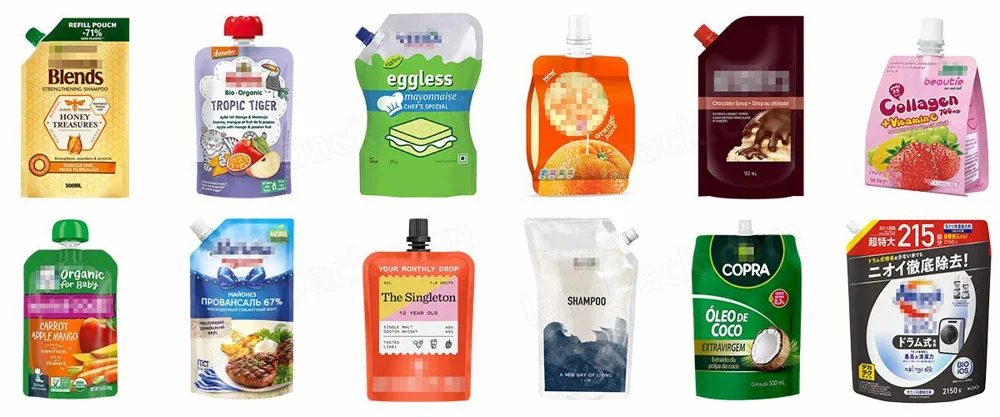 Spout pouches are flexible bags with an integrated dispensing nozzle (spout) that combine the convenience of bottles with the lightweight, space-saving design of stand-up pouches.
They have become extremely popular for liquids and semi-liquids (beverages, sauces, baby food, detergents, etc.) because the screw-on or flip-top spout allows easy pouring and reclosure. Spout pouches can come with the spout in various positions – top-center, corner, or even bottom – but all share the same idea: a built-in channel (the nozzle) for safe, controlled pouring.
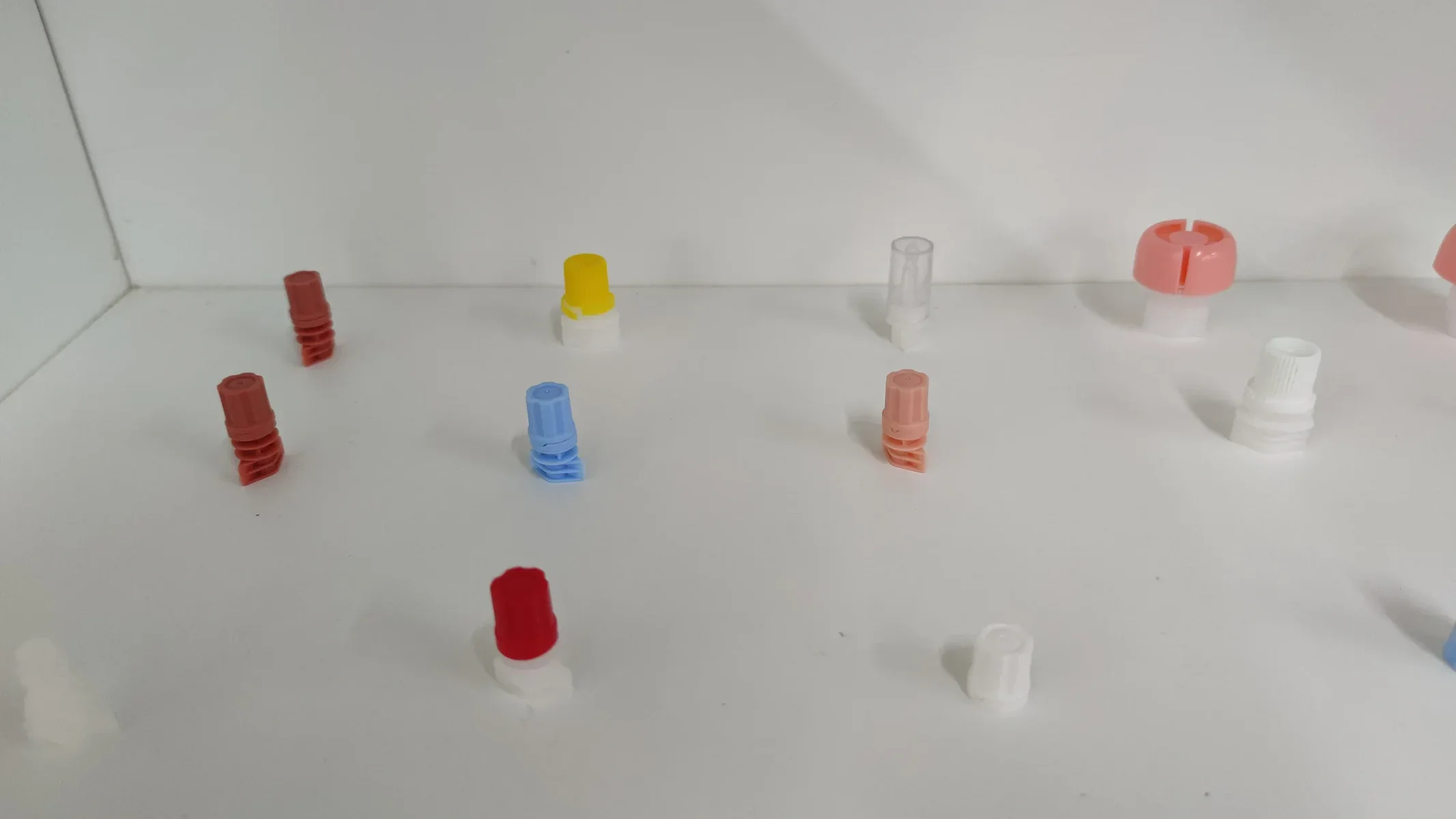
For example, top spout pouches (spout at top-center) are widely used for beverages and sauces, while corner spout pouches (spout at an upper corner) are common for baby foods and condiments to enable precise dispensing. (Some heavy-fluid products even use a bottom-mounted spout for complete drainage.)
Common Spout Styles and Caps
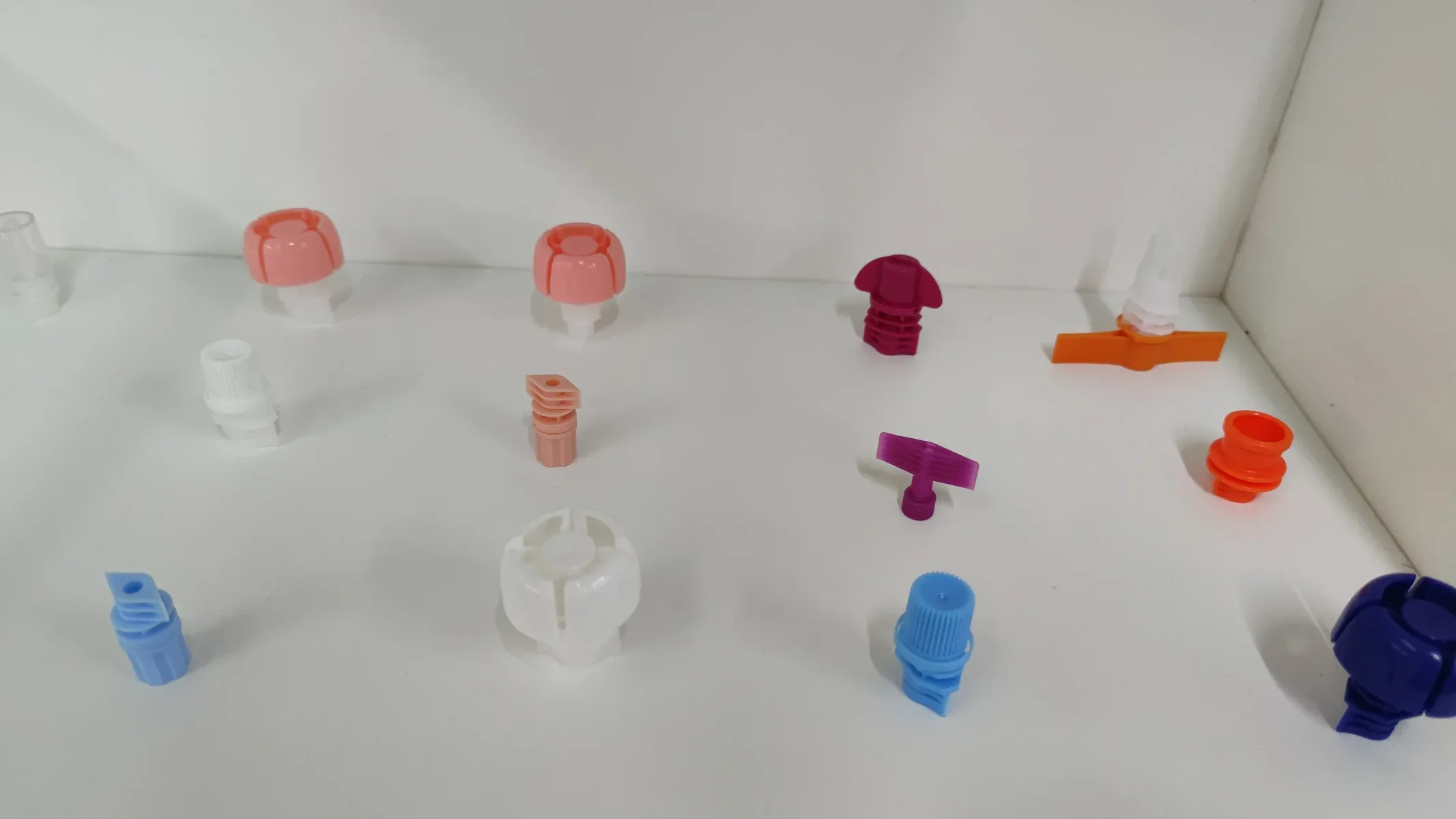
Spout nozzles come in many styles and closure types. Key categories include:
- Screw-cap spouts:These are threaded nozzles with a twist-on cap. They often include a tamper-evident ring (“safety ring” or “security ring”) or a snap-on breakaway seal. (Some manufacturers differentiate “safety-ring” vs. “snap-ring” caps as two variants.) Screw caps are very common because they are easy to use and provide a reliable, leak-proof seal.
- Flip-top spouts:These have a hinged cap (often round or rectangular) that snaps open and closed. Flip caps may have a push-pull design (pull up to open, push down to close) and are convenient for controlled pouring without fully removing a cap. Landpack’s catalog, for example, lists “drink round flip-top spout” and “rectangular flip-top nozzle” as standard options.
- Push/Pull or Press spouts:These valves open only when the pouch is squeezed or when the cap is pulled up. They often have a self-sealing membrane so that the pouch can be resealed without a threaded cap. (In one supplier’s list these appear as “press the nozzle” or valve caps.) They are common on yogurt drinks or baby pouches where one-handed use is desired.
- Specialty nozzles:In some applications (especially household chemicals or medical gels) spouts may have a built-in spray trigger or straw. For example, “trigger sprayer” caps are sometimes used on detergent pouches. Some smoothie pouches even include a removable straw piercing cap.
Each spout style can be made in different shapes (round or rectangular cross-sections) and materials (food-grade PP or PE). Different cap types – screw, flip, child-resistant – can be mated to these spouts. The result is a huge variety of “spout designs” on the market.
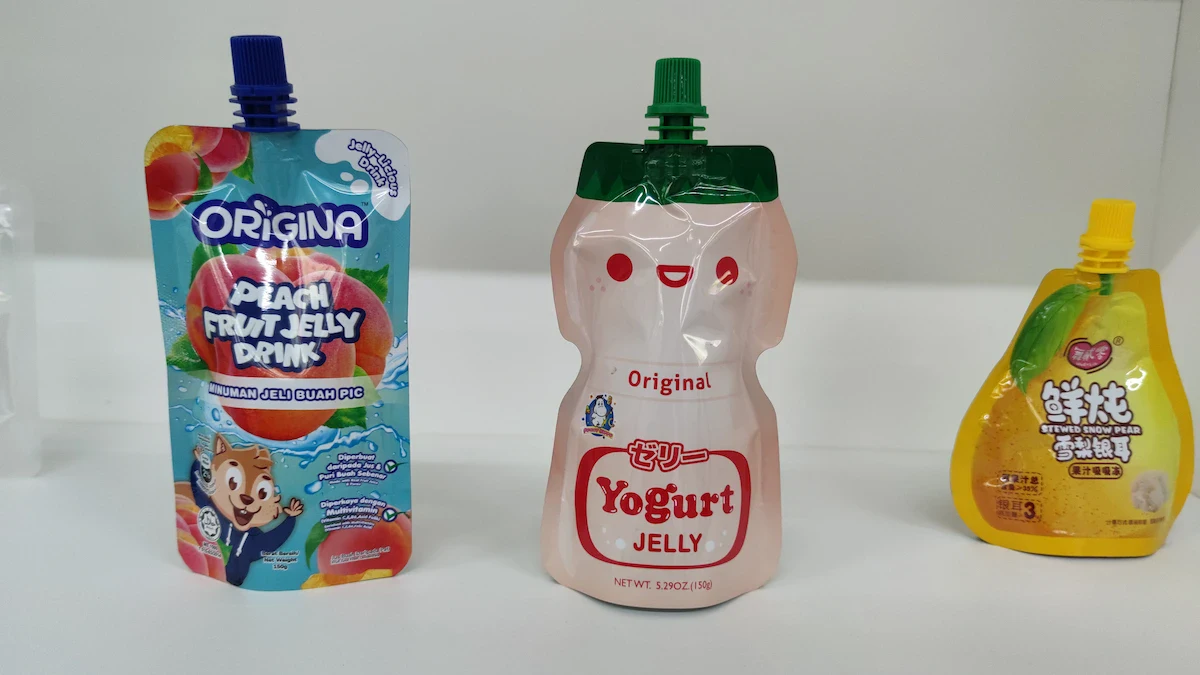
As one manufacturer notes, spout-pouch fitments include everything from standard safety-ring screw caps to snap-on closures, round or rectangular flip-tops, one-way press valves, and even spray nozzle tops. In practice, the chosen spout type depends on the product’s viscosity, usage (on-the-go sipping vs. pouring), and user needs.
Spout Position and Bag Formats

Although the nozzle itself is the focus, the bag shape and spout position also matter. The same spout design (e.g. a screw cap) can be mounted at different bag locations. Common pouch formats are:
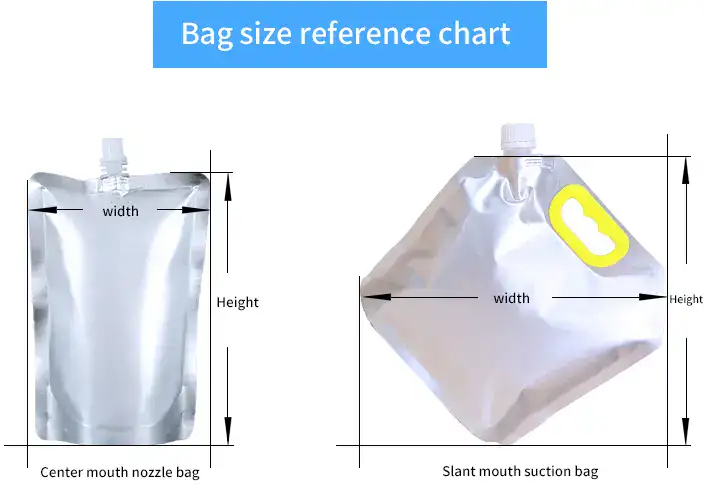
- Stand-up pouches (duffle bags)with a top-center spout. The spout is sealed in the middle of the top seam. These are used for juices, sauces, detergents and similar. Top-center spouts make pouring very intuitive.
- Stand-up pouches with corner spouts.The spout is heat-sealed at one of the upper corners. This is popular for viscous products like baby food, yogurt, or condiments because the corner design helps squeeze out the last drop and offers precise control.
- Flat or pillow poucheswith a spout (less common), often with gussets.
- Bottom-spout pouches(mostly for industrial liquids) where the nozzle is on the pouch bottom. This orientation allows virtually complete drainage – ideal for motor oils or industrial chemicals.
- Nozzle (sipper) pouches.Some use a straw-like valve nozzle (no separate cap at all). These “nozzle pouches” allow sipping or squeezing directly (like energy gel packs).
Across these formats, the underlying spout cap types remain the same. For example, a corner pouch might use a safety-ring screw cap or a flip top spout, just as a top-center pouch would. One supplier’s catalog highlights that their filling machines can handle side spout, corner spout, and center spout pouches alike. In summary, most major spout-pouch designs fall into the categories above, combining one of the spout shapes (round vs. rectangle) and cap styles (screw, flip, etc.) with a chosen pouch format.
Spout Pouch Filling Machines and Production Lines
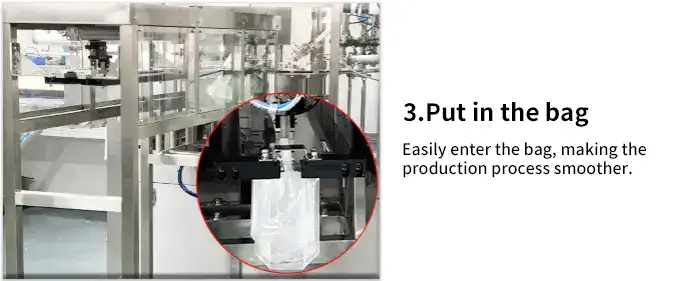
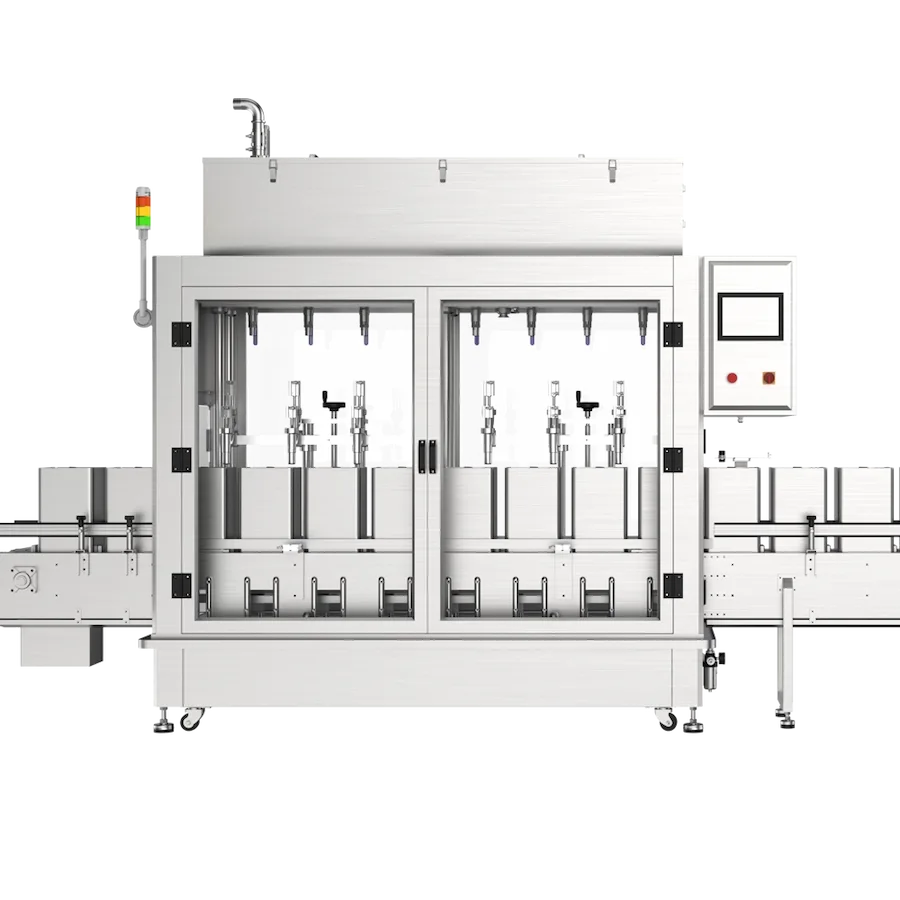
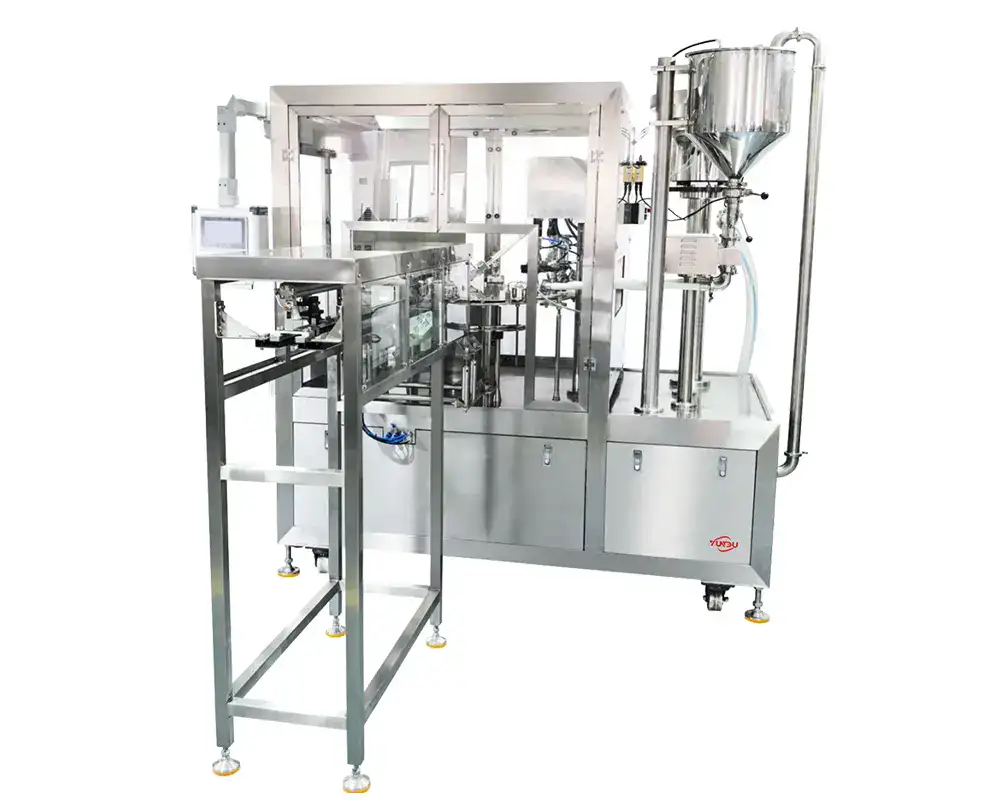
Filling spout pouches requires specialized machinery. A spout pouch filling machine clamps the open pouch by the spout and injects the product through it. Modern machines are fully automated: they feed empty pouches (often pre-made) into the line, position them, dose the liquid or paste through a nozzle, place and tighten the cap, then discharge the sealed pouch.
For example, Yundu Machinery’s double-head spout pouch filler uses a PLC control with a touchscreen, servo-driven pumps and servo-controlled capping, and it “completes pouch feeding, filling, cap placing, and capping in one cycle”.
Typical machines use sanitary stainless-steel pumps (gear, piston or diaphragm types) and can achieve high accuracy. Yundu’s machines boast ±1.5% fill accuracy by design to minimize waste. They accommodate a wide volume range; e.g. the Yundu double-head model fills from 30 mL up to 2000 mL per pouch. A typical speed might be 25–35 pouches per minute per head, though actual speed depends on pouch size and fluid viscosity. (Multi-head versions—4-head, 6-head, etc.—can reach much higher rates by filling several pouches in parallel.)
In practice, a spout pouch production line includes several modules. A simplified sequence is:
- Pouch feeding:Pouches (with spouts pre-inserted) are loaded onto a rotating turret or conveyor. Some machines use a star-wheel that grips each pouch by the neck and rotates it through stations.
- Dosing / filling:A precisely timed pump (or multiple pumps) dispenses the set volume through the spout nozzle into the pouch. The spout (neck) ensures a leak-tight seal around the filling nozzle. Modern systems often mount 6 filling heads in parallel (for example, Landpack’s six-head model) to speed up throughput.
- Cleaning/CIP (optional):For high-hygiene products (dairy, juice, protein drinks, etc.), many lines include a Clean-In-Place (CIP) rinse A special CIP nozzle can flush the filling lines or even spray the outside of the pouch spout to ensure no residue is left. As one case study explains, a juice filling line was built with an “integrated sterilization and CIP system” (plus pasteurization) to meet food-safety standards. Landpack’s machine even specifies a 6-head water-rinsing step after filling in its workflow.
- Capping:After filling, the machine places a cap onto the spout. Caps are fed from a hopper (often using a vibratory bowl feeder) and automatically screwed or pressed on with a torque-controlled capping head. High-end machines can add tamper-evident bands or shrink seals if needed.
- Discharge:The sealed pouch is released onto an exit conveyor. At this point, the filled, capped pouch is ready for labeling or secondary packaging.
Through this integrated process, a spout pouch line can achieve continuous, high-speed output. For example, in a recent Yundu project, the combined system included two parallel filling sections: one for small-volume packs (90–500 mL) and one for large-volume packs (800–2000 mL). The small-section (5 filling heads) ran about 1400–1600 bags/hour for 500 mL pouches, while the large-section (3 heads) ran 1000–1200 bags/hour for 1000 mL pouches. (That corresponds to roughly 23–27 and 17–20 bags per minute, respectively, per machine head.) Another supplier, Landpack, advertises a six-head filler at up to 40 bags/minute (2400 bags/hour), reflecting the extremely high throughputs possible.
Large-scale spout-pouch lines often handle diverse products. The image above shows assorted filled spout pouches (from detergents to juices) produced by one such line. In high-capacity lines, features like servo filling pumps, PLC controls, and quick-change nozzles ensure consistent, accurate filling across different products. Industry reports note that modern spout fillers serve not only food/drink (juices, sauces, yogurt) but also personal care and chemicals. For instance, Landpack explicitly lists “Laundry Detergent, Hand Soap, Shampoo” and other household liquids as typical applications.
Similarly, Yundu’s experience shows these machines in daily-chemical plants as much as dairies, because the design is modular: one can add CIP washers, extra pumps or pasteurization sections as needed. All-metal contact parts (usually 304/316 stainless steel) meet hygiene standards across industries.
Hygiene and Customization (CIP, Pasteurization, etc.)
Our Yundu Machinery sales manager often highlights that in dairy, protein or juice applications, integrated cleaning is crucial. We typically equip these lines with CIP rinsing and even pasteurization tunnels when required.
This ensures the entire filling path stays sanitary between runs. (As one Yundu project notes, a CIP system and controlled heating/cooling were added to make the juice filling fully aseptic.) The machines are designed to be flexible: customers can request extra modules (like spout rinsers, sterilizers or even nitrogen purging) to suit their product. This modularity makes our spout-filling lines “flexible and easy-to-use”, accommodating large volumes in both food and daily-chemical factories. For example, adding a CIP rinse in a detergent line safely removes any product residues.
In summary, spout pouch nozzles come in many styles (screw vs flip vs valve, round vs rectangular, etc.) and positions (top, corner, bottom). Correspondingly, spout-filling machines are highly adaptable. They can be configured with multiple heads, custom pumps, CIP wash steps, and more to match any production need. Yundu’s case studies and product lines illustrate this: from filling protein shakes in pasteurized conditions to packaging high-volume detergents, our machines deliver accurate, high-speed filling of spout pouches.
Key Takeaways:
Modern spout pouches use a range of nozzle types (screw caps, flip tops, etc.) and bag formats (corner vs. top spouts) to suit the product.
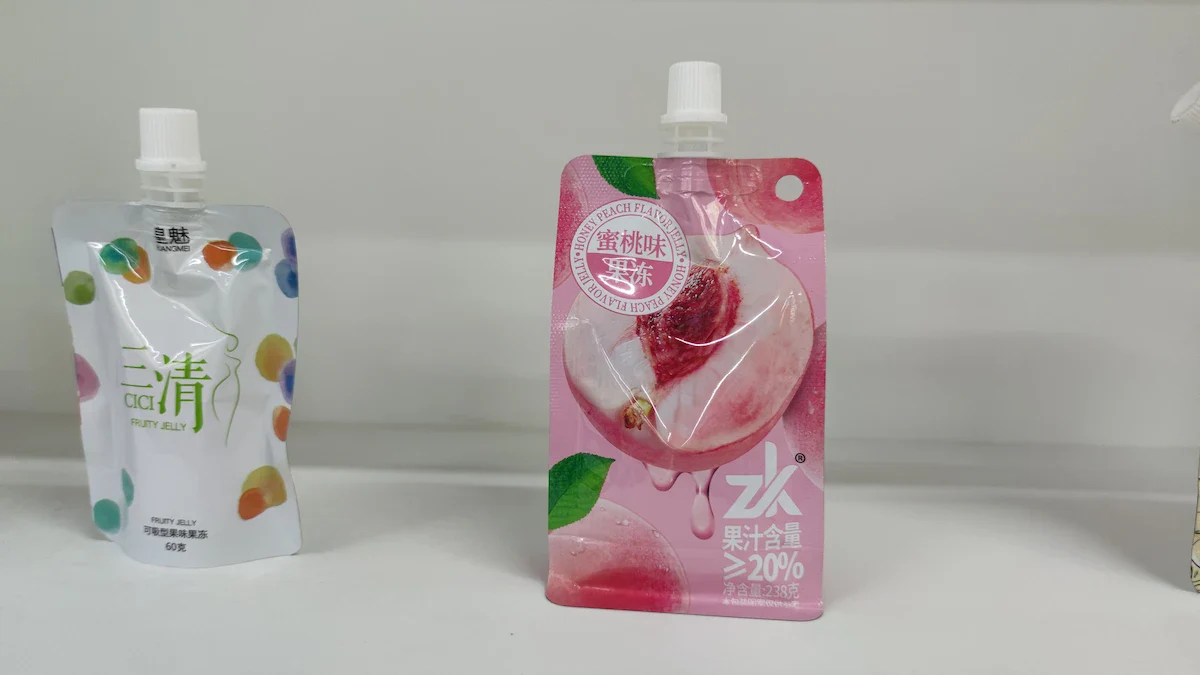
Spout-filling equipment handles these with dedicated modules – including CIP cleaning for dairy and detergents – enabling hygienic, high-output production lines. Leading suppliers (like Yundu and others) emphasize customization and active controls (servo pumps, PLCs) to achieve precision (±1–2%) and efficiency, making spout pouch packaging a top choice for food, beverage, and personal-care manufacturers.
Sources: Industry packaging guides and machinery spec sheets (e.g. GreenBioBag on spout pouch types; Polymaven on fitment options; Yundu Machinery product pages and case studies; Landpack and others on spout-filler features). These detail the spout designs and production-line configurations cited above.
References:
1.Fully Automatic Double-Head Spout Pouch Filling and Capping Machine – Yundu
2.Spout Pouch Filling Line Delivered to Ukrainian Juice Producer