 English
  Arabic
  Indonesian
  Vietnamese
  Malay
Malay  Thai
Thai  Korean
  Russian
  French
  Italian
  Japanese
  Portuguese
  Turkish
  Spanish
 Understanding Liquid Capsule Technology
Liquid-filled hard capsules (LFHC) revolutionize pharmaceutical and nutraceutical manufacturing by combining the convenience of traditional capsules with greater formulation flexibility. Unlike softgels, which require specialized production, liquid-filled hard capsules use chitin hard gelatin or vegetarian capsules to package oils, suspensions, or semi-solid dosage forms. The gap between solid dosage forms and liquid drug systems has been technologically altered to improve the bioavailability of poorly soluble compounds.
Key advantages of liquid-filled capsules
- Improved bioavailability: It indirectly bypasses the dissolution step and absorbs liquid faster.
- Multiple formulation options: Suitable for oils, herbal extracts, and temperature-sensitive actives.
- Anti-counterfeiting design: Band-sealed capsules ensure product accuracy.
- Low production costs: Lower equipment costs compared to softgels.
- Consumer preference: Easier to swallow and consume fragrances than pills.
Types of Liquid Capsule Filling Machines
Choose the right equipment according to the production scale and formulation requirements:
Manual liquid capsule filling machine
Manual liquid capsule filling machine is a hand-operated device designed to fill liquid substances into empty capsules. It is commonly used in small-scale pharmaceutical production, research laboratories, and supplement manufacturing. The machine allows users to manually fill, seal, and assemble capsules, offering a cost-effective solution for low-volume production.
This type of machine is easy to operate, portable, and requires no electricity, making it ideal for small businesses or custom formulations. Although manual liquid capsule filling machines offer precise filling, they are labor-intensive and slower compared to automatic systems, making them suitable for small batches and specialty products.
Semi-automatic liquid capsule filling machine
semi-automatic liquid capsule filling machine. It can fill liquid drugs such as oily liquid, solution, suspension, paste into hollow capsules (000#, 00#, 0#, 1#, 2#, 3#, 4#, 5#). It can automatically sow capsules and innovatively lock capsules horizontally.
The semi-automatic liquid capsule filling machine has transformed the lock capsule structure, saving labor, improving work efficiency, beautiful shape, and meeting GMP production requirements. Semi-automatic liquid capsule machine is a product used by pharmaceutical manufacturers, health care product manufacturers, hospitals for medium-volume production or laboratories.
Easy to operate, stable operation, high cost performance. It is equipped with a capsule protection device and an emergency stop device to ensure the safety of operators in emergency situations.
The capsule sowing station adopts a fully automatic structure, which improves the equipment efficiency and the friction caused by the manual capsule sowing process.

Fully automatic liquid capsule filling machine
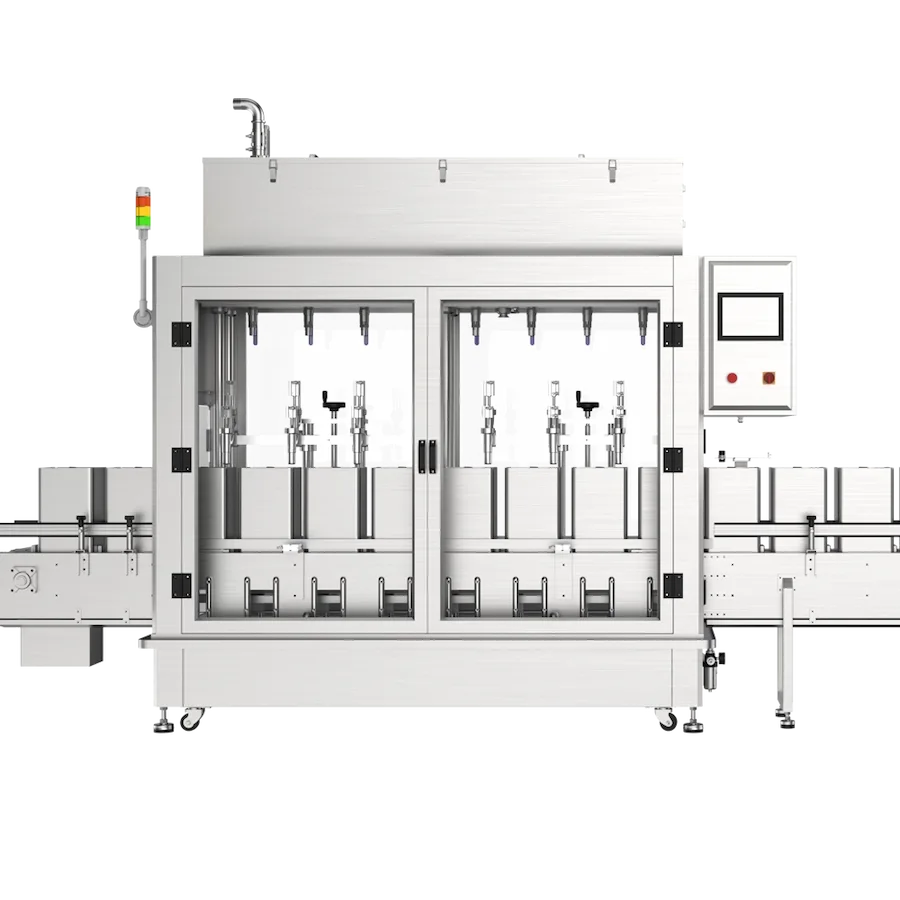
The fully automatic hard capsule liquid filling machine and sealing linkage line equipment is independently developed and designed by our company based on its own hard capsule liquid filling machine and sealing linkage line technology for many years, and has achieved great improvements in performance and output. It is a cost-effective hard capsule filling liquid and sealing linkage line equipment.
The equipment can complete the filling of hard capsules (solutions, suspensions, microemulsions or hot melts) and seal the joint of the capsule cap body, so that the materials in the capsule are always in a sealed state during packaging, transportation and use, thereby improving stability and safety. While ensuring quality, the drug delivery method it provides provides more efficient and stable hard capsule filling liquid and sealing solutions for pharmaceutical companies, health care products factories and other industries. It is a boon for the development of (highly active drugs, poorly soluble drugs) preparation products.

Step-by-Step Liquid Capsule Manufacturing Process
Stage 1: Pre-Production Preparation
- Capsule Selection: Use modified hard-shell capsules with tighter seam tolerances.
- Liquid Formulation: Optimize viscosity (typically 50–500 mPa) to prevent leakage. Additives like silica may stabilize suspensions.
Stage 2: Capsule Feeding & Alignment
- Hopper Loading: Empty capsules are gravity-fed into a vibratory bowl for orientation.
- Vacuum Separation: Precision nozzles split capsule bodies from caps using controlled suction.
Stage 3: Precision Liquid Dosing
- Peristaltic Pump Systems: Deliver ±2% dosing accuracy for oils and viscous liquids.
- Positive Displacement Pumps: handle shear-sensitive biologics without degradation.
Stage 4: Capsule Closing & Inspection
- Mechanical Pressing: Upper and lower dies align caps and bodies under 50–100 N force.
- Vision Systems: Reject capsules with filling errors or sealing defects.
Stage 5: Band Sealing & Quality Assurance
- Gelatin Banding: Apply a 5–10 µm gelatin layer at 40–45°C to create a hermetic seal.
- Leak Testing: Submerge samples in an ethanol/water solution to detect formulation breaches.
Stage 6: Drying & Packaging
- Multi-Zone Drying Tunnels: Reduce moisture content to <8% using 25–30°C airflow.
- Blister Packaging: Use oxygen-scavenging materials to extend shelf life for oxidizable actives.
Critical Quality Control Measures
- Fill Weight Uniformity: Meet USP <905> standards with RSD <6%.
- Seal Integrity Testing: 100% inspection via pressurized decay or dye penetration methods.
- Stability Testing: Accelerated aging studies at 40°C/75% RH for 3–6 months.
- Disintegration Compliance: Ensure capsules dissolve within 30 minutes in simulated gastric fluid.
Overcoming Common Production Challenges
| Issue | Solution |
|---|---|
| Capsule Brittleness | Humidify storage (45–55% RH) pre-filling |
| Liquid Leakage | Optimize viscosity with thickeners |
| Air Bubble Entrapment | Vacuum degassing post-mixing |
| Seal Adhesion Failure | Adjust gelatin concentration (18–22%) |
Applications Across Industries

- Pharmaceuticals: Pediatric antibiotics, CBD/THC formulations, and enteric-coated actives.
- Nutraceuticals: Fish oils, vitamin D3, and CoQ10 for enhanced absorption.
- Cosmeceuticals: Hyaluronic acid and retinoids in anti-aging products.
- Veterinary Medicine: Palatable formulations for pet supplements.
Cost Analysis – Liquid vs. Softgel Capsules
- Equipment Investment: Liquid capsule machines cost 30–50% less than rotary die softgel systems.
- Material Costs: Hard shells are 0.03–0.07/unit vs. softgels at 0.05–0.12/unit.
- Labor Efficiency: Automated lines reduce staffing needs by 40% compared to manual softgel casting.
Future Trends in Liquid Capsule Technology
- Vegetarian Capsules: HPMC and pullulan shells for vegan-friendly products.
- Smart Capsules: Embedded RFID tags for dosage tracking.
- Nanoemulsion Fills: Submicron particle sizes for instant bioavailability.
Conclusion
Mastering liquid capsule production requires understanding formulation science, equipment capabilities, and regulatory requirements. By leveraging advanced filling machines like the CapCN series and implementing rigorous QC protocols, manufacturers can deliver superior liquid-based products with competitive margins. As consumer demand for innovative delivery formats grows, liquid-filled capsules position brands at the forefront of pharmaceutical and nutraceutical innovation.