 English
  Arabic
  Indonesian
  Vietnamese
  Malay
Malay  Thai
Thai  Korean
  Russian
  French
  Italian
  Japanese
  Portuguese
  Turkish
  Spanish
 Which Filling Machine Is Best for Viscous Materials? A Technical Guide to Pump Selection and Yundu’s 4-Head and 8-Head Solutions
When manufacturers need to package shampoo, honey, cream, lotion, mousse, face cream, ointment, detergent, shower gel, or other high-viscosity products, choosing the right Filling machine becomes much more important than simply choosing a machine with a larger number of filling heads.
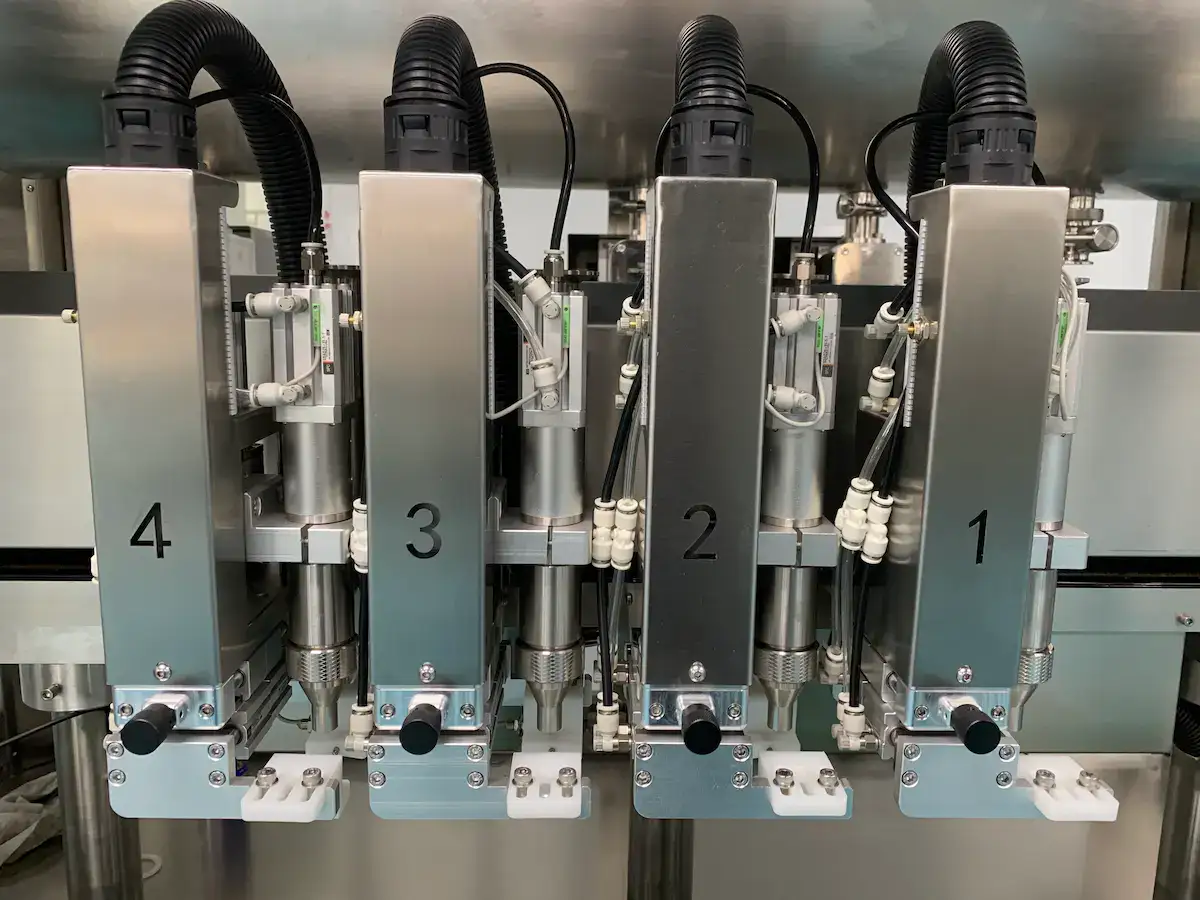
Close-up details of the liquid filling machine’s filling head
Viscous products behave very differently from water-like liquids. Their flow resistance can change with temperature, shear rate, pressure, formulation, and even the design of the filling nozzle. A filling system that works perfectly for water may produce slow filling, dripping, stringing, inconsistent fill weights, or product residue when it handles a thick cream.
So, which filling machine is best for viscous materials?
In most cases, manufacturers should look first at positive-displacement filling technologies, especially servo-controlled piston, rotary piston, gear-metering, and carefully selected peristaltic systems. The best choice depends on the product’s viscosity, rheology, target filling volume, required precision, container dimensions, production speed, hygiene requirements, and cleaning process.

This article explains the engineering principles behind viscous-product filling and introduces Yundu’s 4-head and 8-head servo quantitative filling machines, as well as Yundu’s high-end ceramic pumps and peristaltic pumps, which are also available as individual pump components.
Why Are Viscous Products Difficult to Fill?
The main challenge is flow resistance.
Water has relatively low viscosity and can move rapidly through a pipe or nozzle under a modest pressure difference. A viscous product such as honey, cream, shampoo, or mousse needs substantially more force to move at the same flow rate.

A simplified relationship comes from fluid mechanics:
Pressure loss increases with flow resistance, while flow resistance itself depends strongly on viscosity, passage geometry, and flow conditions.
This means that simply increasing pump speed does not always solve a viscous filling problem. A higher speed can increase pressure losses, cause greater dripping at the nozzle, or create undesirable product behavior.
Recent filling studies confirm this relationship. Research published in the Journal of Pharmaceutical Sciences found that increasing viscosity can increase friction and head loss through filling tubing and nozzles, while larger nozzles can help reduce these effects for high-viscosity products.
Viscous products also frequently exhibit non-Newtonian behavior. Their apparent viscosity may change when the applied shear rate changes. Shampoo, cosmetic creams, gels, and many food products can therefore behave differently during tank storage, pumping, and nozzle discharge.
This is why a professional Filling machine must be designed around the actual product instead of relying only on a nominal viscosity number.
What Makes a Good Filling Machine for Viscous Materials?
A suitable Filling machine should provide four key capabilities:
| Requirement | Why It Matters for Viscous Products |
|---|---|
| Positive-displacement dosing | Delivers a controlled quantity rather than relying only on gravity |
| Servo-controlled metering | Allows operators to adjust speed, acceleration, and filling stages |
| Anti-drip/no-drip nozzle | Reduces strings, drops, and product accumulation |
| Flexible recipe control | Allows different products, volumes, and filling parameters |
A fifth factor also deserves attention: the relationship between the pump and nozzle.
A powerful pump cannot compensate for an incorrectly sized nozzle. A small nozzle can create excessive pressure loss, while a nozzle that is too large may reduce dosing stability and make the final cut-off more difficult.
For this reason, Yundu recommends evaluating the complete product-contacting system—including tank, pipes, pump, valves, filling nozzles, control parameters, and containers—rather than selecting a pump independently from the filling machine.
Which Pump Is Best for High-Viscosity Filling?
There is no single pump that is ideal for every viscous product. The following technologies are commonly considered.

Magnetic Pump Filling Machine YD-1-1
| Pump technology | Typical strengths | Considerations | Suitable applications |
| Servo piston / rotary piston pump | Accurate volumetric dosing, strong pressure capability | Requires proper clearance, cleaning and product compatibility | Creams, pharmaceutical liquids, cosmetics |
| Gear pump | Stable continuous metering, compact structure | Internal leakage and shear characteristics require evaluation | Oils, detergents, liquid chemicals |
| Peristaltic pump | Product contacts only the tubing, flexible and hygienic | Tubing, backpressure and pump settings affect accuracy | Pharmaceuticals, biotech, sensitive liquids |
| Ceramic piston pump | High precision, wear-resistant contact components, suitable for demanding dosing | Higher-end component selection and engineering | Pharmaceutical and precision filling |
| Auger/screw pump | Handles viscous and semi-solid materials | More suitable for certain thick products and feeding duties | Pastes, semi-solids, very high-viscosity products |
A study in the Journal of Modern Manufacturing Systems and Technology examined auger-pump performance when handling high-viscosity liquids and demonstrated that viscosity affects the pump’s operating performance and flow behavior.
For many conventional cosmetic, food, chemical, and household products, however, a servo-driven positive-displacement Filling machine provides an excellent balance of precision, speed, flexibility, and controllability.
1. Servo Gear-Metering Filling Machine
Yundu’s filling solutions can use high-precision gear-based quantitative metering, driven by a servo system.
The basic concept is straightforward: the pump meters a defined quantity while the servo motor controls the rotational movement. By connecting pump displacement, servo rotation, and filling parameters through the PLC, operators can adjust the filling process without relying on manual mechanical adjustment.
This approach can be particularly useful for medium- and high-viscosity products where stable volumetric dosing is required.
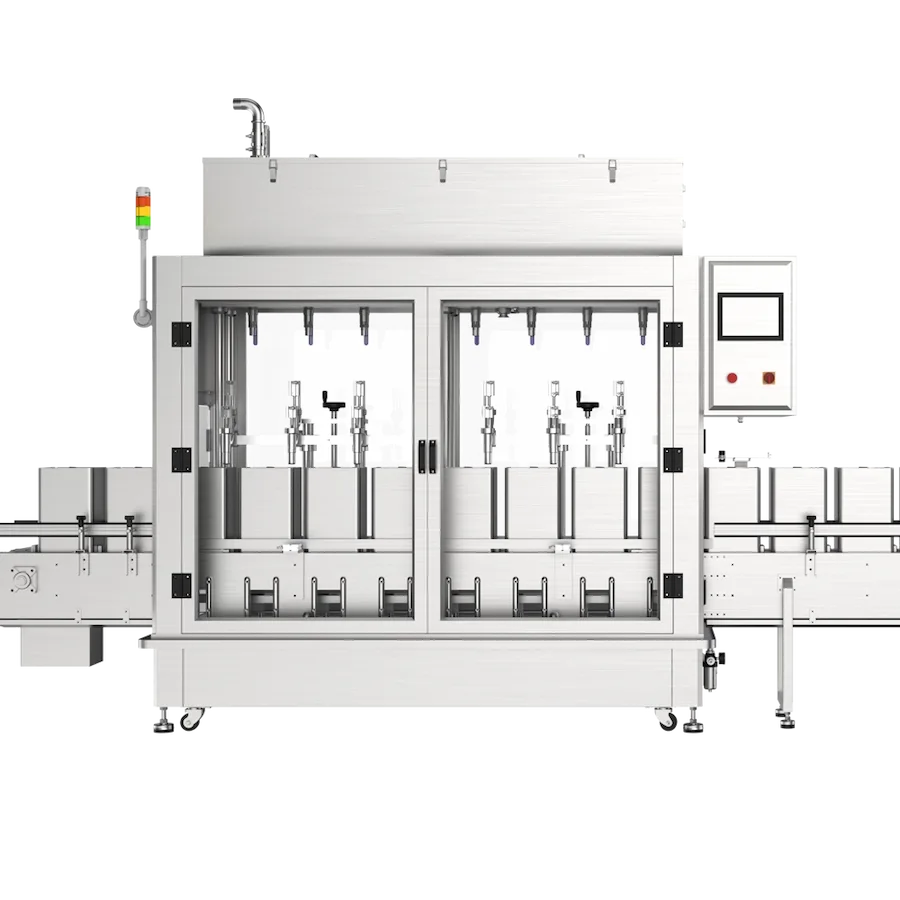
For example, Yundu’s 8-head configuration is designed around:
- 8 independently controlled filling heads
- Filling range approximately 20–1000 mL, depending on product and container
- Servo quantitative filling
- High-precision gear metering
- Approximately 40–55 bottles/minute for a reference 300 g mousse application
- Multi-stage filling
- Anti-drip filling nozzles
- Air-break function for improved cut-off performance
- PLC + touchscreen control
- Recipe storage
- 304 stainless-steel machine frame
The actual production speed and accuracy depend strongly on product characteristics, bottle geometry, target volume, temperature, and filling parameters.
This point is important: the number of filling heads does not determine the final output by itself.
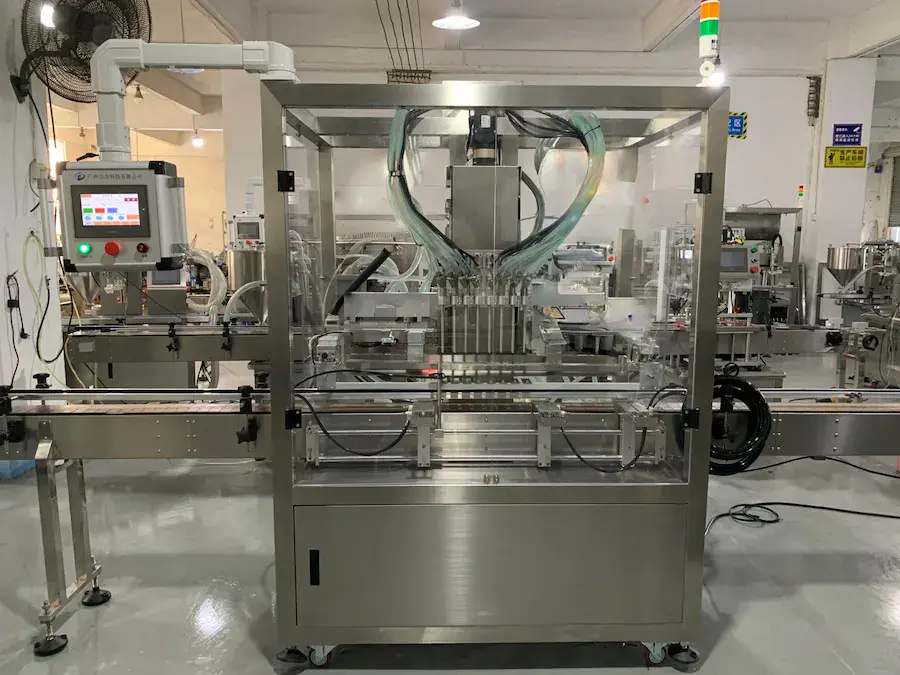
Eight heads do not automatically mean double the speed of four heads. The product’s filling time, bottle spacing, nozzle movement, pump recovery time, and downstream handling all influence actual output.
2. Yundu 4-Head Filling Machine for Larger Filling Volumes
For applications requiring larger volumes or different operating conditions, Yundu also offers a 4-head independently controlled filling configuration.
The reference specifications include:
- 4 independently controlled filling heads
- Approximately 30–5000 mL filling range, depending on product and packaging
- Servo quantitative filling
- High-precision gear metering
- Approximately 70–100 bottles/minute under a reference 300 mL shampoo application
- Multi-stage filling capability
- 200 recipe storage
- 0.6–0.8 MPa operating air pressure
- 304 stainless-steel construction
- Approximately 114 mm tank-chain conveyor
- Servo-driven conveyor and filling system
- Automatic liquid feeding with tank level control
- Anti-drip filling nozzles
- Bottle-height adaptability
The machine can also support tracking-type filling configurations, including parallel or interval tracking modes, depending on the final machine design.
This configuration makes the 4-head Filling machine interesting for products such as shampoo, shower gel, detergent, liquid soap, honey, sauces, creams, and other viscous materials where the required fill volume can vary considerably.
3. Why Servo Control Matters for Viscous Filling
Servo control provides an important advantage because viscous products do not always respond well to a simple constant-speed filling profile.
Consider a 500 mL shampoo bottle.
At the beginning of filling, the nozzle may need a higher flow rate to achieve good productivity. As the liquid approaches the target level, however, reducing the flow rate can help minimize splashing, foaming, dripping, or excessive product movement.
A servo system can therefore implement a multi-stage filling profile.
For example:
Stage 1: Fast filling
Stage 2: Medium-speed filling
Stage 3: Slow filling
Stage 4: Final dosing and cut-off
This technique becomes especially valuable when working with products that contain air bubbles, exhibit shear-thinning behavior, or become difficult to control near the end of the filling cycle.
4. Why Nozzle Design Is Critical for Viscous Products
Pump selection receives most of the attention, but nozzle design can have an equally important influence on filling performance.
Research published in the Journal of Pharmaceutical Sciences found that nozzle size influences head loss, dripping behavior, and filling accuracy. Larger nozzles can help reduce flow resistance when high-viscosity products require filling.
A viscous product may also create a “string” between the nozzle and the bottle. Instead of forming a clean drop, the material stretches during nozzle withdrawal.
This creates several problems:
- Product contamination on the container neck
- Weight variation
- Poor visual appearance
- Product accumulation around the nozzle
- Additional cleaning requirements
Yundu therefore uses anti-drip filling nozzle designs with air-break functionality for applicable viscous-product applications.
However, the best nozzle diameter should always be determined through testing with the real product and container.
5. The Technical Role of the Ceramic Pump

For demanding applications, Yundu can also supply high-end ceramic pumps separately, not only as part of a complete Filling machine.
Ceramic rotary piston technology has attracted significant attention in pharmaceutical filling because pump material and surface interactions can influence product quality.
A study published in Biotechnology and Bioengineering investigated protein formulations filled with ceramic rotary piston pumps. The researchers found that pump-surface interactions could influence particle formation, while elemental analysis showed that ceramic wear debris remained at trace levels and did not appreciably contribute to protein aggregation in the studied conditions.
Another study reported that, under its tested conditions, a stainless-steel rotary piston pump generated more protein aggregates than a ceramic pump head.
More recent research in the Journal of Pharmaceutical Sciences has continued to investigate how pump materials, clearances, and flow-path architecture influence particle formation during fill-finish operations. The work compared peristaltic pumping with ceramic and stainless-steel rotary piston systems.
 These findings do not mean that ceramic pumps automatically provide the best result for every product. They demonstrate an important engineering principle:
Pump material can become a critical process variable when the product is sensitive to surface interaction, contamination, wear, or mechanical stress.
For high-value pharmaceutical and precision dosing applications, this makes ceramic pump technology particularly interesting.
6. Yundu Peristaltic Pumps: A Different Filling Principle
Yundu also specializes in peristaltic pumps, which can be supplied as part of a Filling machine or sold separately.
A peristaltic pump moves liquid by compressing flexible tubing in a controlled sequence. Only the tubing contacts the product.
This architecture provides several advantages:
- Reduced product contact with pump components.
- Convenient tubing replacement.
- Useful separation between the product and mechanical pump components.
- Strong suitability for sterile or contamination-sensitive processes.
- Flexible integration into laboratory, pilot, and industrial filling systems.
Peristaltic pumps have long been used in pharmaceutical filling, particularly for biologic products. Research has examined their behavior in high-concentration and high-viscosity formulations.
However, the phrase “peristaltic pump equals perfect accuracy” would be misleading.
A 2025 study found that viscosity, filling volume, tubing size, pump speed, acceleration/deceleration, and suck-back all have statistically significant effects on fill-volume variability.
Even more recent research published in 2026 demonstrated that peristaltic pumps can experience reduced flow when backpressure exceeds a certain threshold, with the effect becoming particularly relevant when filling viscous liquids.
This is a valuable lesson for machine buyers:
The best pump is not simply the pump with the highest theoretical accuracy. It is the pump that maintains stable performance under the real operating conditions of the product.
Ceramic Pump vs. Peristaltic Pump
The choice between a ceramic pump and a peristaltic pump depends on the application.
| Factor | Ceramic Rotary Piston Pump | Peristaltic Pump |
| Product contact | Pumping components contact product | Mainly tubing contacts product |
| Volumetric dosing | Excellent potential | Excellent when correctly characterized |
| High-viscosity filling | Very suitable for many precision applications | Suitable, but backpressure must be controlled |
| Tubing replacement | Not applicable | Important maintenance consideration |
| Product contamination concerns | Material and surface engineering are critical | Tubing material is critical |
| Pharmaceutical applications | Highly relevant | Highly relevant |
| Cleaning approach | Depends on pump design | Tubing replacement/CIP strategy depends on system |
| Precision requirements | Suitable for demanding dosing | Suitable when operating parameters are optimized |
| Separate pump supply | Available from Yundu | Available from Yundu |
The scientific literature supports a balanced view. Peristaltic pumps can offer strong advantages because only the tubing contacts the product, while rotary piston technologies can provide highly controlled positive-displacement dosing. However, both technologies require proper engineering and process characterization.
Which Filling Machine Should You Choose?
A practical selection process should start with the product rather than the machine.
| Product situation | Recommended direction |
| Shampoo and shower gel | Servo gear-metering Filling machine |
| Liquid detergent | Servo positive-displacement filling |
| Honey | Servo filling with suitable large-bore nozzle |
| Cosmetic cream | Servo piston/gear or suitable positive-displacement system |
| Mousse | Servo filling with optimized nozzle and multi-stage control |
| Pharmaceutical high-value liquids | Ceramic piston or peristaltic system depending on formulation |
| Sterile/biologic products | Peristaltic or ceramic piston after process evaluation |
| Very thick semi-solids | Special piston or screw/auger-type feeding may be required |
| Small-volume precision pharmaceutical filling | High-precision ceramic or peristaltic technology |
The most important parameters to provide to the Filling machine manufacturer are:
Product name + viscosity + density + filling volume + container dimensions + required bottles/minute + product temperature + whether the product contains particles + foaming tendency + hygiene requirements.
A simple viscosity number alone often does not tell the entire story.
For example, two products can both have a measured viscosity of 5,000 cP but behave differently because one may shear-thin significantly while the other remains relatively stable.
How Yundu Approaches Viscous Product Filling
Yundu’s approach focuses on matching the pump, nozzle, servo parameters, container, and production speed instead of treating the Filling machine as a standardized standalone product.
For viscous products, Yundu can provide:
4-head servo quantitative Filling machines
Designed for flexible filling volumes and higher production requirements, with a reference filling range of approximately 30–5000 mL and configurable multi-stage filling.
8-head servo quantitative Filling machines
Designed for applications requiring multiple independently controlled filling heads, with a reference range of approximately 20–1000 mL.
High-end ceramic pumps
Suitable for customers who require precision pump components for demanding dosing applications. Yundu can also supply ceramic pumps separately for integration into existing equipment or replacement projects.
Peristaltic pumps
Suitable for pharmaceutical, biotechnology, laboratory, and other applications where product-contact architecture and flexible tubing are important. Yundu can also provide peristaltic pumps independently.
Conclusion: The Best Filling Machine Is the One Matched to the Product
So, which Filling machine is suitable for viscous materials?
For many cosmetic, food, household chemical, and general industrial applications, a servo-controlled positive-displacement Filling machine is an excellent starting point. Yundu’s 4-head and 8-head configurations provide flexible options for different filling volumes, production rates, and container formats.
For highly demanding pharmaceutical applications, ceramic rotary piston pumps and peristaltic pumps deserve special consideration. Current research shows that viscosity, nozzle size, pump speed, tubing dimensions, backpressure, pump materials, and suck-back behavior can all influence filling performance.
Therefore, choosing the right Filling machine should never be reduced to one question such as “How many filling heads do I need?”
The better question is:
What pump and filling architecture can deliver the required volume, accuracy, speed, hygiene, and product quality under my actual production conditions?
That is where engineering, product testing, and machine customization make the difference.
Yundu provides complete Filling machine solutions as well as ceramic pumps and peristaltic pumps as individual components, allowing customers to purchase either a complete filling line or the specific dosing technology required for an existing production system.