
 English
 Arabic
 Indonesian
 Vietnamese
 Malay
 Thai
 Korean
 Russian
 French
 Italian
 Japanese
 Portuguese
 Turkish
 Spanish
Automatic blister cup filling and sealing machine
With this machine, you can fill and seal liquids, creams, jellies, coffee pods, dairy products such as yogurt, cheese, and butter, and sauces

Cup Filling and Sealing Machine Types
Yundu’s automatic blister cup machine has the highest quality servo motors and filling molds for outstanding performance. Our machines can significantly reduce production line costs while improving accuracy and productivity; they are also cost effective, so manufacturers can stay competitive.
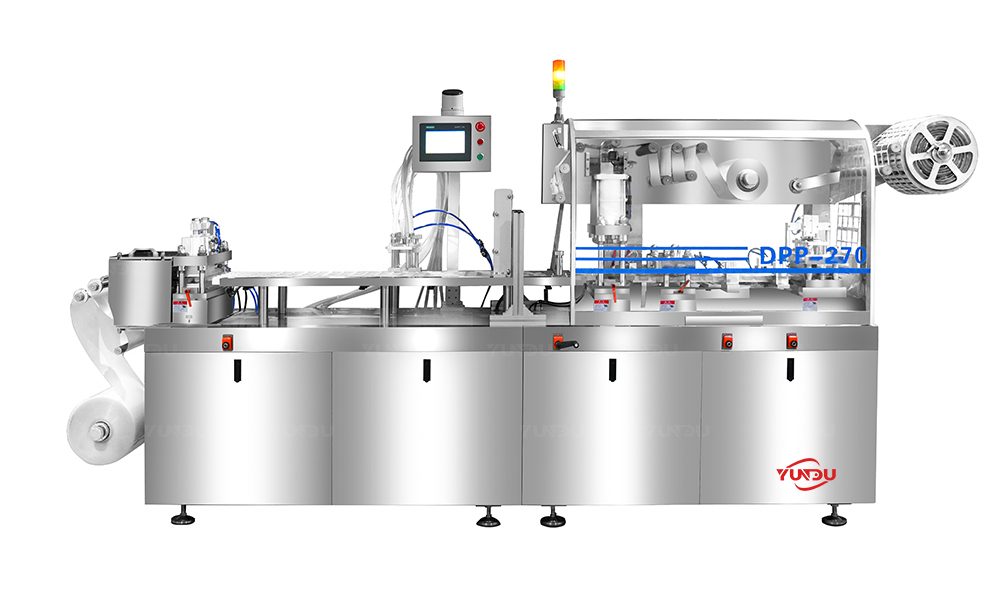
The DPP-270 Blister Cup Filling and Sealing Machine is a high-efficiency packaging solution designed for filling semi-liquid and viscous products such as butter, cheese, jelly, and hot sauce. Equipped with a lifting workbench, the machine allows for quick and convenient mold changes and easier access for maintenance. It integrates automatic cup feeding, precise volumetric filling, and high-strength heat sealing in a streamlined process. Built with a stainless steel frame and a user-friendly control system, the DPP-270 ensures hygienic operation, consistent performance, and reduced downtime—making it ideal for medium to large-scale food and pharmaceutical production environments.

The DPP-180 Blister Cup Filling and Sealing Machine is a compact, high-precision packaging solution designed for automatic filling and sealing of pre-formed blister cups. Ideal for food, pharmaceutical, and cosmetic applications, this machine features a stainless steel structure, servo-driven filling system, and a reliable heat sealing mechanism to ensure hygienic, leak-proof packaging. It supports a wide range of products including creams, gels, liquids, and pastes, with customizable cup sizes and sealing materials.

The DPP-80 is controlled by a PLC and can automatically form, feed, heat seal, crease, punch, etc.
It is suitable for filling and sealing viscous liquids such as Olive oil, tomato paste, butter, cheese, etc.
Technical Specifications of DPP Series Blister Machines
| Parameter | DPP-80 | DPP-180 | DPP-270 | DPP-350 | DPP-420S | DPP-420S-II |
|---|---|---|---|---|---|---|
| Production Capacity | 1,200–1,980 plates/hour | 180 cups/min | 15–50 cycles/min | 160 cups/min | 10–35 cycles/min | 10–35 cycles/min |
| Max. Forming Area & Depth | 80×105×25 mm | 165×125×26 mm | 250×130×28 mm | 165×125×26 mm | 390×150×26 mm | 390×150×26 mm |
| Standard Stroke Range | 35–80 mm | 40–125 mm | 30–130 mm | 40–125 mm | 40–160 mm | 40–160 mm |
| Air Pressure Requirement | 0.6–0.8 MPa | 0.6–0.8 MPa | 0.4–0.6 MPa | 0.6–0.8 MPa | 0.4–0.7 MPa | 0.4–0.7 MPa |
| Air Supply Flow | — | ≥0.4 m³/min | ≥0.3 m³/min | ≥0.4 m³/min | ≥0.35 m³/min | ≥0.35 m³/min |
| Total Power | 2.4 kW | 5.5 kW | 9 kW | 5.5 kW | 9.7 kW | 22 kW |
| Main Motor Power | 0.75 kW | — | — | — | 2.2 kW | 2.2 kW |
| PVC Film Size | 0.15–0.5×120 mm | 0.2–0.5×175 mm | 0.15–0.5×250 mm | 0.2–0.5×175 mm | 0.25–0.5×420 mm | 0.25–0.5×420 mm |
| PTP Aluminum Foil Size | 0.02–0.035×120 mm | 0.02–0.03×175 mm | 0.02–0.035×250 mm | 0.02–0.03×175 mm | 0.02–0.035×420 mm | 0.02–0.035×420 mm |
| Mold Cooling | Tap water or recirculated | Tap water or recirculated | Tap water or recirculated | Tap water or recirculated | Tap water or recirculated | Tap water or recirculated |
| Machine Dimensions (L×W×H) mm | 1,996×592×1,229 | 2,786×602×1,530 | 4,200×650×1,640 | 2,786×602×1,530 | 4,000×950×1,600 | 5,700×950×2,000 |
| Machine Weight | 450 kg | 900 kg | 1,500 kg | 900 kg | 1,800 kg | 2,000 kg |
- Production capacity for DPP-80 is in plates/hour; others are in cups/min or cycles/min
- Standard plate/cup size not specified for 420 series
- Noise index and eye-marking systems are model-specific and not included
Contact Our Team
Not sure which blister packaging machine is right for you?
To discover which of our blister machines best suits your business, please feel free to contact us.
Features & Benefits of Our Blister Packaging Machines
Multiple Blister Packaging Options
We provide different liquid blister solutions; ideal for pet syrup, yogurt cups, and surprise eggs.
Food Packaging OEM
We not only provide you with blister machinery, but also provide packaging services.
Customized Service
We provide customized services based on your cup size, mold size, filling speed, and desired servo motor.
High-Speed Production
The number of molds can be increased as your production capacity expands, up to 12 rows of molds, achieving 10,000 cups/hour.
Video or Field Inspection
You can check the machine's status and performance through WhatsApp video or by visiting the Yundu factory.
Wholesale Discounts
On orders of 3 or more units, you will get a 30% discount and an additional year of technical support.
Application Cups
Applied for yogurt, coffee capsules, jelly, surprise eggs……

Coffee K Cups

Surprise Eggs

Yogurt

Jelly
How Does it Work?
Step 1: Enter the parameters into the machine and prepare the materials, including the liquid and the rolls of packaging film.
Step 2: The machine is running; the mold slowly transfers and fills the materials from left to right.
Step 3: Cutting, patterning, date printing, heat sealing, waste removal, finished product.
Common Questions
Transparency is the cornerstone of our Yundu team, so here are the most common questions and answers we receive surrounding our liquid filling systems.
A blister packaging machine automates the process of forming, filling, sealing and cutting individual cavities (“blisters”) in plastic film, then sealing them to a backing (foil, paperboard or card). It’s widely used in pharmaceuticals, electronics and consumer goods for tamper‑evident, moisture‑protective, unit‑dose packaging.
Common alternatives include skin packaging (thin film vacuum‑sealed to a backing card), stretch or stretch‑card packaging (flexible film wrapped and glued), and traditional carded packaging (product affixed to card with plastic dome). These methods offer varied cost, sustainability and visual‑appeal trade‑offs.
A blister pack uses pre‑formed rigid plastic cavities sealed to foil or board, whereas skin packaging drapes a heated, flexible plastic film over the product and card, vacuum‑sealing it to form a “skin.” Blister packs protect defined doses; skin packs conform tightly around irregular shapes.
Blister packs provide individual-dose protection, clear visibility, tamper evidence and reduced medication waste. Bottles (HDPE, PET, PP) are easier to recycle and reseal but lack unit‑dose accuracy. Selection depends on product sensitivity, patient compliance needs and sustainability goals.
Many pharmacies are reducing blister services due to high labor and equipment costs, lack of insurance reimbursement, and sustainability concerns over non‑recyclable waste. Automated bottle filling and pre‑manufactured compliance packs often offer more cost‑efficient, eco‑friendly alternatives.
Key challenges include difficult curbside recycling (mixed plastics/foil), high material and tooling costs, user‑accessibility issues for those with dexterity limits, and environmental impact from PVC/foil waste. Manufacturers are exploring mono‑materials and bio‑plastics to mitigate these issues.
Next‑gen blister packs will integrate smart features (RFID, QR codes), use eco‑friendly materials (rPET, PLA, mono‑films), and leverage AI‑driven quality control. Trends include blockchain traceability, child‑resistant/senior‑friendly designs, and circular‑economy recycling programs.
Traditional blister packs combine PVC or PP plastic with aluminum foil and sometimes paperboard. These laminated layers aren’t separable by standard recycling streams, making kerbside processing unfeasible. Specialized take‑back schemes (e.g., TerraCycle, Pharmacycle) are required.
Blister‑line capital investment, custom tooling, validation and barrier films make blister packaging generally more expensive per unit than bottles or simple card packs. Costs can be offset by reduced product waste, enhanced shelf‑life and compliance benefits.
Yes. Because filling and sealing blister packs is labor‑intensive and often not reimbursed by insurers, pharmacies commonly levy an additional fee to cover staff time, specialized equipment and material costs.
Several organizations (e.g., TerraCycle, Pharmacycle) run free take‑back programs via participating pharmacies and clinics. These schemes aggregate used blister packs for specialized recycling processes that separate plastic and foil.
Blister packs are also called “push‑through packs” (PTP), “unit‑dose packaging,” “blister cards” or sometimes “bubble packs” in marketing contexts.
Monomaterial pouches, eco‑laminates, recyclable HPDE‑based blister systems (e.g., AmSky™), and digital health‑enabled dispensers are emerging replacements, offering easier recycling or enhanced patient adherence tracking.
A “bubble pack” typically refers to cushioning packaging (like bubble wrap), whereas a “blister pack” is rigid, thermoformed plastic sealed to backing for retail or pharmaceutical unit‑dosing. The two serve distinct protective and presentation roles.
Pharmaceutical blister packs must comply with Good Manufacturing Practices (GMP), USP <661> (plastic materials), EP 3.1.11 (PVC non‑plasticized materials), FDA 21 CFR 211.132 (tamper evidence), and often serialization/track‑and‑trace regulations to ensure safety and integrity.