One Filling Machine for Multiple Liquid Products: Is It Possible?

Table of Contents

Can a single Liquid Filling Machine bottle every liquid formula in a cosmetics or agricultural facility—from water-thin extracts to thick creams and aggressive acids?
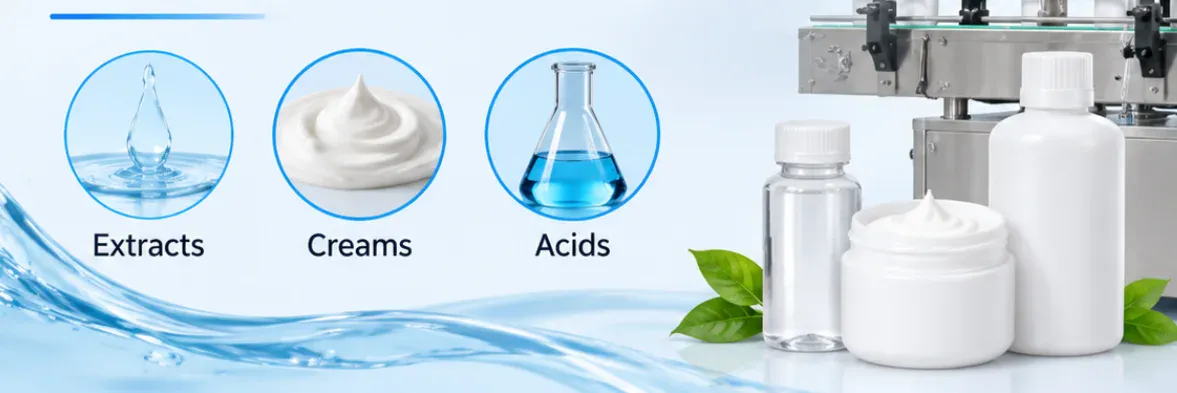
Materials of varying viscosities

Materials of varying viscosities

No—not with a one-size-fits-all pump. While one machine frame can adjust fill volumes from 100 ml to 1,000 ml, a single pump configuration cannot reliably handle drastically different viscosities at the same time.

Many buyers search for a Multi Product Liquid Filling Machine hoping one standard setup will fill thin hydrosols, viscous serums, and corrosive agricultural liquids interchangeably. In real production, fluid physics sets strict limits. A magnetic pump excels with thin, water-like liquids, whereas viscous products demand positive-displacement pumps such as piston, rotor, or gear pumps.

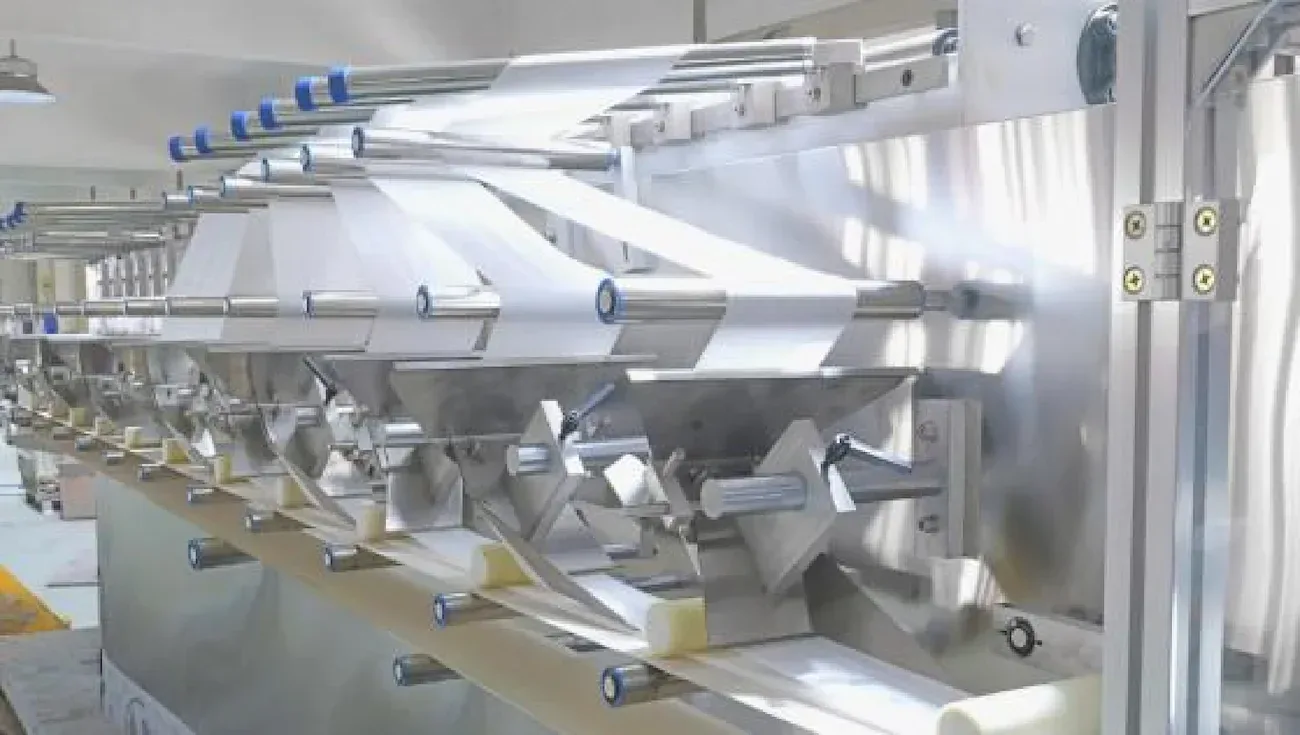
16-head follow-up filling machine

Let’s set the engineering record straight—explaining what an 8-head Liquid Filling Machine (capable of 50–60 bottles per minute at 100 ml) can and cannot do, how pump selection works, and how to build a practical Automatic Liquid Filling and Capping Line for cosmetics and agricultural liquids.
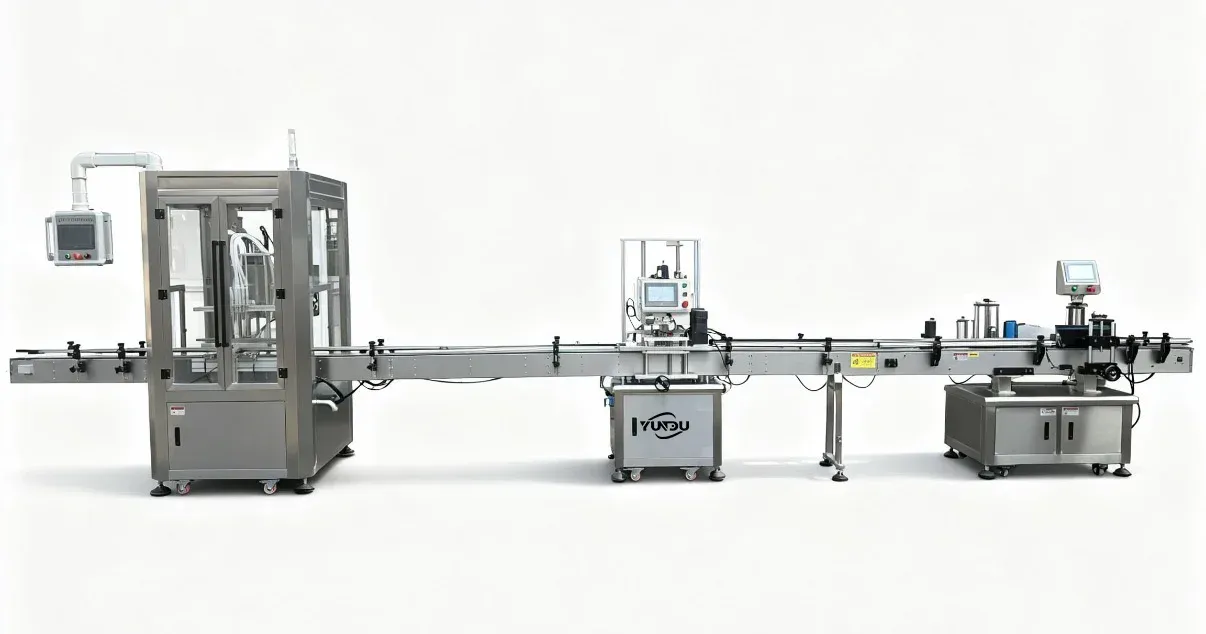
Yundu - Filling Production Line Assets-1

Yundu – Filling Production Line Assets

The Reality of Multi-Product Filling in Cosmetics & Agriculture

Bottle Filling Machine

Cosmetics and agricultural liquid producers often manage dozens of SKUs across different bottle sizes. You might run 100 ml bottles of floral toner or foliar nutrient in the morning and switch to 500 ml or 1,000 ml containers in the afternoon.

A machine’s volume range is flexible, but its pump architecture must match the physical behavior of your liquid:

  • Volume flexibility (100–1,000 ml): An 8-head linear filler adjusts fill volume smoothly across 100 ml to 1,000 ml containers via PLC settings and nozzle height adjustments.

  • Viscosity limits: One machine cannot uniformly fill both thin, free-flowing liquids and thick, viscous formulas using the same pump type.

  • Particulate limits: Standard magnetic pumps require particle-free liquids. Any suspended solids or crystals can jam or damage internal impellers.

💡 Insight from Luna, Sales Manager at Yundu:

“Clients frequently ask if one 8-head magnetic pump machine can run everything from thin toners to thick lotions. We always clarify upfront: a magnetic pump cannot handle viscous products. While the machine adjusts easily from 100 ml to 1,000 ml, we must select the pump type—magnetic, piston, rotor, or corrosion-resistant—based on your actual product samples.”

⚙️ Why Pump Selection Depends on Viscosity (Not Just Volume)?

When evaluating a Liquid Filling Machine for Different Viscosities, you must separate fill volume adjustment from fluid rheology.

What a Magnetic Pump Can and Cannot Do?

An 8-head Liquid Filling Machine equipped with magnetic drive pumps is ideal for thin, water-like, particle-free liquids—such as cosmetic hydrosols, toners, alcohol-based sprays, and free-flowing liquid fertilizers.

  • How it works: As documented in engineering references on Wikipedia regarding magnetic drive pumps, magnetic coupling transfers motor torque to the impeller through a containment shell without a dynamic shaft seal.

  • Why it works for thin liquids: High-speed impeller rotation delivers clean, repeatable flow for low-viscosity fluids at roughly 50–60 bottles per minute for 100 ml containers.

  • Why it fails on thick liquids: Magnetic pumps rely on centrifugal/impeller dynamics that lose efficiency and stall when fluid viscosity rises. They cannot pump thick serums, creams, or viscous agricultural suspensions.
Pump TechnologyBest Liquid ViscosityParticle ToleranceTypical Cosmetic / Agricultural Fit
Magnetic PumpThin, water-like (low viscosity)None (particle-free only)Toners, hydrosols, watery plant nutrients
Corrosion-Resistant Pump (PTFE/PVDF/Alloy)Thin to medium (varies by pump head)None (unless specialized)Acidic agricultural liquids, low-pH actives
Piston PumpMedium to high viscositySmall, soft particles (with proper valves)Lotions, thick serums, concentrated emulsions
Rotor / Lobe PumpHigh viscosity, sticky, or shear-sensitiveGentle on soft particulatesCreams, gels, viscous organic fertilizers

If your facility bottles both water-thin liquids and thick pastes, purchasing two dedicated filling systems—or consulting engineers on interchangeable pump skids—protects Liquid Filling Accuracy far better than forcing one pump outside its operating window.

Solving Foaming & Acid Corrosion in Cosmetics and Agriculture

Beyond viscosity, two real-world challenges dictate how we engineer your line: foam generation and chemical corrosion.

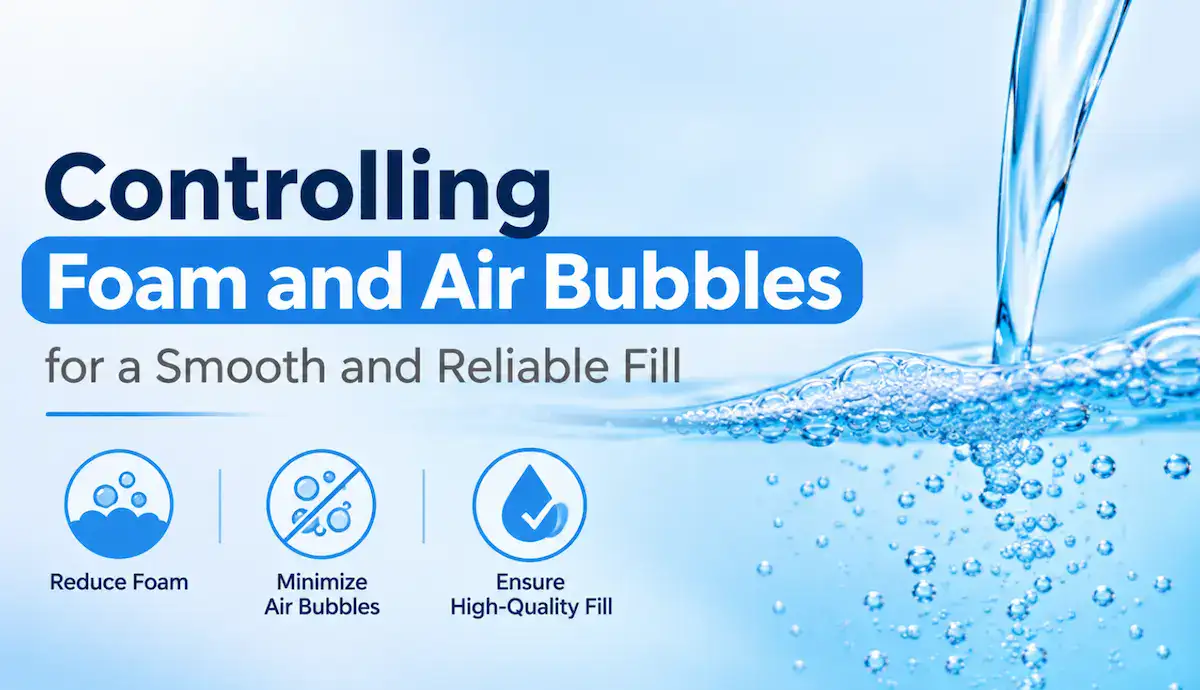
1. Controlling Foam and Air Bubbles

Controlling Foam and Air Bubbles

Many botanical extracts, surfactant cleansers, and agricultural wetting agents foam aggressively during high-speed filling. Air bubbles distort fill levels, cause messy overflow, and ruin cap seals.

A properly configured Foaming Liquid Filling Machine eliminates turbulence through mechanical and software controls:

  • Bottom-up (diving) nozzles: Filling nozzles descend to the bottom of the 100 ml or 1,000 ml bottle and rise smoothly just above the liquid surface as it fills.

  • Multi-stage speed curves: The PLC starts filling slowly to prevent splashing at the bottle base, ramps up mid-fill, and tapers off at the end.

  • Anti-drip shutoff: Pneumatic or positive-shutoff nozzles prevent trailing drops from foaming on the bottle neck.

2. Building a Corrosive Liquid Filling Machine

Automated liquid filling machine for beverage, chemical, and oil industries.

Agricultural formulations—such as acid-based foliar feeds, pH adjusters, and organic acid concentrates—along with acidic cosmetic actives (like AHA/BHA solutions) rapidly corrode standard 304 or even 316L stainless steel wetted parts.

A true Corrosive Liquid Filling Machine (and Chemical Bottle Filling Machine) requires dedicated anti-corrosion engineering:

  • Anti-corrosion pumps: When agricultural products are acidic or corrosive, standard pumps fail quickly. You must specify corrosion-resistant pumps constructed with fluoropolymers (PTFE, PVDF), ceramic components, or specialized corrosion-resistant alloys matched to your exact chemical concentration and pH.

  • Non-metallic wetted paths: Acid-grade tubing, seals (such as Viton/FKM or PTFE), and non-metallic nozzle tips prevent pitting, swelling, and product contamination.

Patent literature in chemical dosing and corrosive liquid filling consistently emphasizes isolating metallic drive components from acidic media using fluoropolymer-lined pump chambers and submerged anti-foam nozzles to preserve equipment lifespan and dosing precision.

Accuracy, Batch Size & Custom Line Integration

Why Liquid Filling Accuracy Drives ROI?

Liquid Filling Accuracy directly determines product yield and regulatory compliance. Research published in packaging and process engineering journals—such as Packaging Technology and Science and Journal of Food Engineering—demonstrates that dosing repeatability depends on matching pump mechanics to fluid viscosity, eliminating air entrainment, and maintaining stable feed pressure.

  • Overfilling costly cosmetic actives or concentrated agricultural inputs erodes profit margins on every shift.

  • Underfilling violates net-content regulations and triggers customer complaints.

Small Batch vs. Custom Production Lines

Not every manufacturer runs millions of identical bottles. Many growing brands operate on a Small Batch Liquid Filling Machine model, switching between 100 ml, 250 ml, 500 ml, and 1,000 ml bottles across multiple SKUs.

  • A Small Bottle Liquid Filling Machine configuration handles lightweight 100 ml bottles cleanly with adjustable guardrails and anti-tipping conveyor guides.

  • A Custom Liquid Filling Machine stores digital recipes on the touchscreen HMI—saving fill time, pump speed, and nozzle diving depth for each container size from 100 ml to 1,000 ml.

Configuring an Automatic Liquid Filling and Capping Line

As shown in linear packaging layouts—featuring an enclosed multi-head filler on the left, a central capping station, and an inline labeling unit on the right—turning a standalone filler into an Automatic Liquid Filling and Capping Line requires matching downstream equipment to your actual containers:

  • Capping (Automatic Liquid Filling and Capping Machine): Capping heads cannot be chosen blindly. Screw caps, trigger sprayers, dropper caps, pump dispensers, and chemical tamper-evident caps each require specific chuck or spindle designs and torque controls.

  • Labeling: Wrap-around labeling for round 100–1,000 ml bottles differs from front-and-back labeling for flat cosmetic or agricultural containers.

💡 Insight from Luna, Sales Manager at Yundu:

“Never choose a capping or filling setup from a brochure alone. Send us your actual liquid samples and bottles—including caps and labels. We verify viscosity, foaming behavior, acid resistance, and cap torque on real hardware so your line runs smoothly from day one.”

🔗 Engineering Real-World Lines with Yundu

At Yundu, we design filling and packaging equipment around verified material properties rather than unrealistic universal claims. You can explore our linear filling systems and technical guides on the Yundu Filling Machine website and browse practical industry insights on the Yundu Blog.

When specifying an 8-head Liquid Filling Machine or complete Automatic Liquid Filling and Capping Line for cosmetics or agriculture, our engineering workflow covers:

  1. Material testing first: Confirming whether your liquid is water-thin (suitable for a magnetic pump) or viscous (requiring piston or rotor pumps), and verifying zero solid particles.

  2. Anti-corrosion specification: Upgrading to dedicated corrosion-resistant pumps and fluoropolymer wetted parts whenever acidic agricultural or cosmetic formulas are involved.

  3. Flexible 100–1,000 ml changeover: Configuring 8 filling heads to deliver roughly 50–60 bottles per minute at 100 ml while scaling smoothly up to 1,000 ml.

  4. Tailored downstream integration: Matching capping chucks and labeling heads to your exact bottle shapes and closures.

Pre-Purchase Checklist for Buyers

Before requesting a quote for a Liquid Filling Machine, gather these five essential facts:

  1. Test real viscosity: Separate water-thin formulas from thick, viscous liquids—never expect one magnetic pump to fill both.

  2. Verify particle-free status: Confirm whether liquids contain any suspended solids, powders, or crystals.

  3. Check pH and corrosiveness: Identify acidic agricultural or cosmetic products that require dedicated anti-corrosion pumps and seals.

  4. Define container range & speed: Confirm bottle dimensions from 100 ml to 1,000 ml and target output (e.g., 50–60 bpm at 100 ml).

  5. Specify actual caps and labels: Share physical cap and bottle samples so your Automatic Liquid Filling and Capping Line matches your real packaging.

Configure Your Pre-Filled Syringe Production Line with Yundu

Whether you are launching a new pre-filled saline flush line, scaling up viscous hyaluronic acid dermal fillers, or upgrading pharmaceutical aseptic filling capacity, matching your container format to the right filling architecture ensures high yield and cGMP compliance.

Contact Yundu’s engineering team today for a customized line layout, throughput assessment, and technical proposal. Share your syringe specifications (0.5 mL to 50 mL), incoming component format, and hourly output targets to receive tailored equipment recommendations.

Leave a Comment

Your email address will not be published. Required fields are marked *

Share The Post Now:
Picture of Hey there, I’m Daisy

Hey there, I’m Daisy

I’m the Sales manager of Yundu. We have been helping manufacturing industries increase their productivity and capacity with our advanced filling machines for over 20 years.
Have questions? Reach out to us, and we will provide you with a perfect solution.

Related Articles

Get Instant Quote

If you’d prefer, a representative from Yundu can contact you directly. Please provide the information below and a member of our sales team will contact you shortly. * fields are required.