Can a single Sıvı Dolum Makinesi bottle every liquid formula in a cosmetics or agricultural facility—from water-thin extracts to thick creams and aggressive acids?
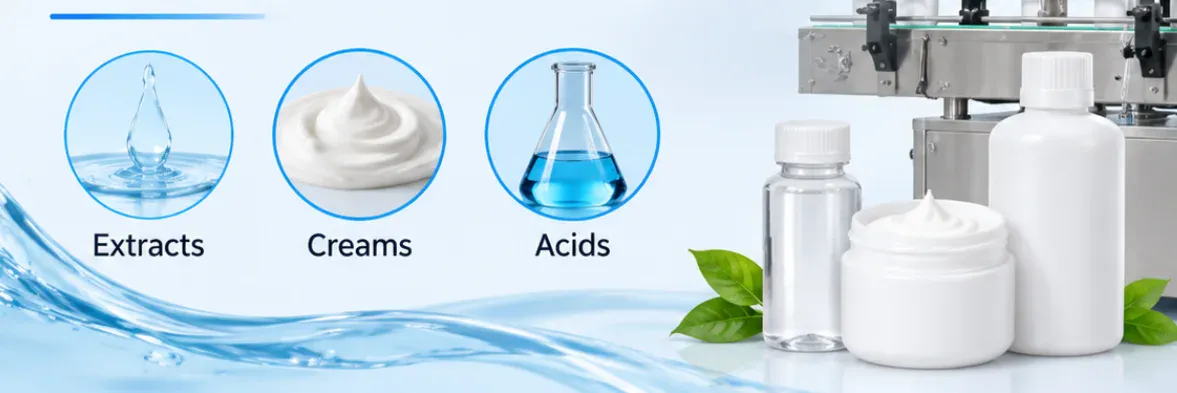
Materials of varying viscosities
No—not with a one-size-fits-all pump. While one machine frame can adjust fill volumes from 100 ml to 1,000 ml, a single pump configuration cannot reliably handle drastically different viscosities at the same time.
Many buyers search for a Multi Product Liquid Filling Machine hoping one standard setup will fill thin hydrosols, viscous serums, and corrosive agricultural liquids interchangeably. In real production, fluid physics sets strict limits. A magnetic pump excels with thin, water-like liquids, whereas viscous products demand positive-displacement pumps such as piston, rotor, or gear pumps.

Let’s set the engineering record straight—explaining what an 8-head Sıvı Dolum Makinesi (capable of 50–60 bottles per minute at 100 ml) can and cannot do, how pump selection works, and how to build a practical Automatic Liquid Filling and Capping Line for cosmetics and agricultural liquids.
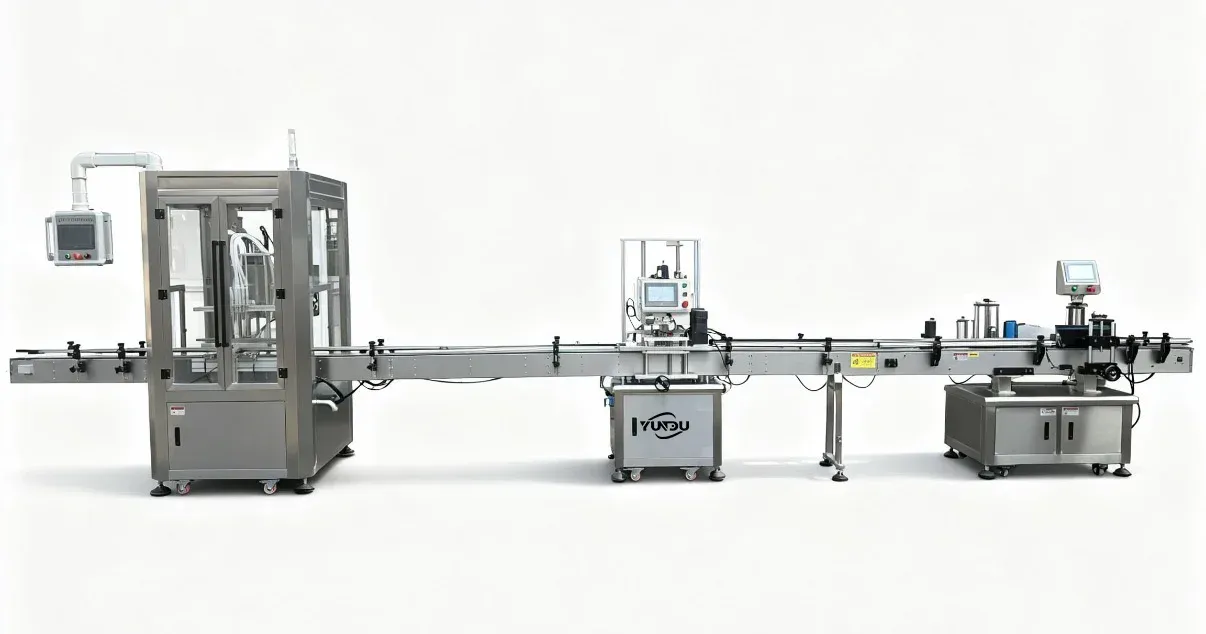
Yundu – Filling Production Line Assets
The Reality of Multi-Product Filling in Cosmetics & Agriculture

Cosmetics and agricultural liquid producers often manage dozens of SKUs across different bottle sizes. You might run 100 ml bottles of floral toner or foliar nutrient in the morning and switch to 500 ml or 1,000 ml containers in the afternoon.
A machine’s volume range is flexible, but its pompa architecture must match the physical behavior of your liquid:
Volume flexibility (100–1,000 ml): An 8-head linear filler adjusts fill volume smoothly across 100 ml to 1,000 ml containers via PLC settings and nozzle height adjustments.
Viscosity limits: One machine cannot uniformly fill both thin, free-flowing liquids and thick, viscous formulas using the same pump type.
Particulate limits: Standard magnetic pumps require particle-free liquids. Any suspended solids or crystals can jam or damage internal impellers.
💡 Insight from Luna, Sales Manager at Yundu:
“Clients frequently ask if one 8-head magnetic pump machine can run everything from thin toners to thick lotions. We always clarify upfront: a magnetic pump cannot handle viscous products. While the machine adjusts easily from 100 ml to 1,000 ml, we must select the pump type—magnetic, piston, rotor, or corrosion-resistant—based on your actual product samples.”
⚙️ Why Pump Selection Depends on Viscosity (Not Just Volume)?
Birini değerlendirirken Liquid Filling Machine for Different Viscosities, you must separate fill volume adjustment itibaren fluid rheology.
What a Magnetic Pump Can and Cannot Do?
An 8-head Sıvı Dolum Makinesi equipped with magnetic drive pumps için idealdir thin, water-like, particle-free liquids—such as cosmetic hydrosols, toners, alcohol-based sprays, and free-flowing liquid fertilizers.
How it works: As documented in engineering references on Wikipedia regarding magnetic drive pumps, magnetic coupling transfers motor torque to the impeller through a containment shell without a dynamic shaft seal.
Why it works for thin liquids: High-speed impeller rotation delivers clean, repeatable flow for low-viscosity fluids at roughly 50–60 bottles per minute for 100 ml containers.
Why it fails on thick liquids: Magnetic pumps rely on centrifugal/impeller dynamics that lose efficiency and stall when fluid viscosity rises. They cannot pump thick serums, creams, or viscous agricultural suspensions.
| Pump Technology | Best Liquid Viscosity | Particle Tolerance | Typical Cosmetic / Agricultural Fit |
|---|---|---|---|
| Manyetik Pompa | Thin, water-like (low viscosity) | None (particle-free only) | Toners, hydrosols, watery plant nutrients |
| Corrosion-Resistant Pump (PTFE/PVDF/Alloy) | Thin to medium (varies by pump head) | None (unless specialized) | Acidic agricultural liquids, low-pH actives |
| Piston Pump | Medium to high viscosity | Small, soft particles (with proper valves) | Lotions, thick serums, concentrated emulsions |
| Rotor / Lobe Pump | High viscosity, sticky, or shear-sensitive | Gentle on soft particulates | Creams, gels, viscous organic fertilizers |
If your facility bottles both water-thin liquids and thick pastes, purchasing two dedicated filling systems—or consulting engineers on interchangeable pump skids—protects Liquid Filling Accuracy far better than forcing one pump outside its operating window.
Solving Foaming & Acid Corrosion in Cosmetics and Agriculture
Beyond viscosity, two real-world challenges dictate how we engineer your line: foam generation Ve chemical corrosion.
1. Controlling Foam and Air Bubbles

Many botanical extracts, surfactant cleansers, and agricultural wetting agents foam aggressively during high-speed filling. Air bubbles distort fill levels, cause messy overflow, and ruin cap seals.
A properly configured Foaming Liquid Filling Machine eliminates turbulence through mechanical and software controls:
Bottom-up (diving) nozzles: Filling nozzles descend to the bottom of the 100 ml or 1,000 ml bottle and rise smoothly just above the liquid surface as it fills.
Multi-stage speed curves: The PLC starts filling slowly to prevent splashing at the bottle base, ramps up mid-fill, and tapers off at the end.
Anti-drip shutoff: Pneumatic or positive-shutoff nozzles prevent trailing drops from foaming on the bottle neck.
2. Building a Corrosive Liquid Filling Machine

Agricultural formulations—such as acid-based foliar feeds, pH adjusters, and organic acid concentrates—along with acidic cosmetic actives (like AHA/BHA solutions) rapidly corrode standard 304 or even 316L stainless steel wetted parts.
A true Corrosive Liquid Filling Machine (and Chemical Bottle Filling Machine) requires dedicated anti-corrosion engineering:
Anti-corrosion pumps: When agricultural products are acidic or corrosive, standard pumps fail quickly. You must specify corrosion-resistant pumps constructed with fluoropolymers (PTFE, PVDF), ceramic components, or specialized corrosion-resistant alloys matched to your exact chemical concentration and pH.
Non-metallic wetted paths: Acid-grade tubing, seals (such as Viton/FKM or PTFE), and non-metallic nozzle tips prevent pitting, swelling, and product contamination.
Patent literature in chemical dosing and corrosive liquid filling consistently emphasizes isolating metallic drive components from acidic media using fluoropolymer-lined pump chambers and submerged anti-foam nozzles to preserve equipment lifespan and dosing precision.
Accuracy, Batch Size & Custom Line Integration
Why Liquid Filling Accuracy Drives ROI?
Liquid Filling Accuracy directly determines product yield and regulatory compliance. Research published in packaging and process engineering journals—such as Ambalaj Teknolojisi ve Bilimi Ve Gıda Mühendisliği Dergisi—demonstrates that dosing repeatability depends on matching pump mechanics to fluid viscosity, eliminating air entrainment, and maintaining stable feed pressure.
Overfilling costly cosmetic actives or concentrated agricultural inputs erodes profit margins on every shift.
Underfilling violates net-content regulations and triggers customer complaints.
Small Batch vs. Custom Production Lines
Not every manufacturer runs millions of identical bottles. Many growing brands operate on a Small Batch Liquid Filling Machine model, switching between 100 ml, 250 ml, 500 ml, and 1,000 ml bottles across multiple SKUs.
A Small Bottle Liquid Filling Machine configuration handles lightweight 100 ml bottles cleanly with adjustable guardrails and anti-tipping conveyor guides.
A Custom Liquid Filling Machine stores digital recipes on the touchscreen HMI—saving fill time, pump speed, and nozzle diving depth for each container size from 100 ml to 1,000 ml.
Configuring an Automatic Liquid Filling and Capping Line
As shown in linear packaging layouts—featuring an enclosed multi-head filler on the left, a central capping station, and an inline labeling unit on the right—turning a standalone filler into an Automatic Liquid Filling and Capping Line requires matching downstream equipment to your actual containers:
Capping (Automatic Liquid Filling and Capping Machine): Capping heads cannot be chosen blindly. Screw caps, trigger sprayers, dropper caps, pump dispensers, and chemical tamper-evident caps each require specific chuck or spindle designs and torque controls.
Etiketleme: Wrap-around labeling for round 100–1,000 ml bottles differs from front-and-back labeling for flat cosmetic or agricultural containers.
💡 Insight from Luna, Sales Manager at Yundu:
“Never choose a capping or filling setup from a brochure alone. Send us your actual liquid samples and bottles—including caps and labels. We verify viscosity, foaming behavior, acid resistance, and cap torque on real hardware so your line runs smoothly from day one.”
🔗 Engineering Real-World Lines with Yundu
Şu anda Yundu, we design filling and packaging equipment around verified material properties rather than unrealistic universal claims. You can explore our linear filling systems and technical guides on the Yundu Filling Machine website and browse practical industry insights on the Yundu Blog.
When specifying an 8-head Sıvı Dolum Makinesi or complete Automatic Liquid Filling and Capping Line for cosmetics or agriculture, our engineering workflow covers:
Material testing first: Confirming whether your liquid is water-thin (suitable for a magnetic pump) or viscous (requiring piston or rotor pumps), and verifying zero solid particles.
Anti-corrosion specification: Upgrading to dedicated corrosion-resistant pumps and fluoropolymer wetted parts whenever acidic agricultural or cosmetic formulas are involved.
Flexible 100–1,000 ml changeover: Configuring 8 filling heads to deliver roughly 50–60 bottles per minute at 100 ml while scaling smoothly up to 1,000 ml.
Tailored downstream integration: Matching capping chucks and labeling heads to your exact bottle shapes and closures.
Pre-Purchase Checklist for Buyers
Before requesting a quote for a Sıvı Dolum Makinesi, gather these five essential facts:
Test real viscosity: Separate water-thin formulas from thick, viscous liquids—never expect one magnetic pump to fill both.
Verify particle-free status: Confirm whether liquids contain any suspended solids, powders, or crystals.
Check pH and corrosiveness: Identify acidic agricultural or cosmetic products that require dedicated anti-corrosion pumps and seals.
Define container range & speed: Confirm bottle dimensions from 100 ml to 1,000 ml and target output (e.g., 50–60 bpm at 100 ml).
Specify actual caps and labels: Share physical cap and bottle samples so your Automatic Liquid Filling and Capping Line matches your real packaging.
Yundu ile Önceden Doldurulmuş Şırınga Üretim Hattınızı Yapılandırın
İster yeni bir önceden doldurulmuş salin solüsyonu hattı piyasaya sürüyor olun, ister viskoz hyaluronik asit dermal dolgu maddelerinin üretimini artırıyor olun, ister farmasötik aseptik dolum kapasitesini yükseltiyor olun, kap formatınızı doğru dolum mimarisiyle eşleştirmek yüksek verim ve cGMP uyumluluğu sağlar.
Özelleştirilmiş hat düzeni, verimlilik değerlendirmesi ve teknik teklif için bugün Yundu'nun mühendislik ekibiyle iletişime geçin. Size özel ekipman önerileri almak için şırınga özelliklerinizi (0,5 mL ila 50 mL), gelen bileşen formatını ve saatlik üretim hedeflerinizi paylaşın.